⚠️ Each post starts with a question, stemming from my ongoing search to know God and His purpose for humanity. It reflects my current view—born from study and wonder—and I often revisit and update as I learn more clearly.
When you hear the phrase “the glory of God,” what comes to mind?
For many, it’s thunder and lightning on a mountain, dazzling light, or a frightening show of power. But when Scripture itself speaks of God’s glory, the picture is far richer—and far more surprising.
Moses begged to see it.
Isaiah saw it filling the earth.
Luke proclaimed it as salvation for all people.
John declared that it became flesh and dwelt among us.
From Sinai to the temple, from the prophets to the Gospels, God’s glory has always been more than human imagination expected. This is the story of Glory That Fills the Earth—what His glory truly is, and why it still fills the earth today.
What Does “Glory” Actually Mean?
Before exploring how God’s glory was revealed throughout history, we need to understand what the word itself meant to those who first used it.
In Hebrew, the word translated as “glory” is כָּבוֹד (kāḇôḏ)
Kavod literally means:
Weight
Heaviness
Substance
But in Hebrew thought, to be “heavy” did not merely describe physical mass. It meant:
Significant
Valuable
Substantial
Worthy of honor
So kavod already carried the idea of the substance of who someone truly is:
Their character.
Their actions.
Their integrity.
Their presence.
Now enter Greek — the most widely spoken language of the Mediterranean world in the time of Jesus. Jewish communities throughout the empire used the Greek translation of the Scriptures known as the Septuagint.
When Jewish translators in Alexandria rendered kavod into Greek, they chose the word δόξα (dóxa).
In earlier classical Greek, doxa primarily meant:
Opinion
Belief
Judgment
What seems to be
It comes from the verb δοκέω (dokeō), meaning:
To appear
To think
To suppose
Over time, especially in Hellenistic usage, doxa expanded to include what is recognized or acknowledged about someone — their standing, their honor, or public reputation.
When kavod was translated as doxa, something profound occurred.
The Hebrew idea of weight — the substance of who someone is — merged with the Greek idea of recognized or revealed identity.
Glory became the weight of who someone truly is, made visible and acknowledged.
This linguistic bridge prepares us for what follows.
“Show Me Your Glory”: Moses on Sinai
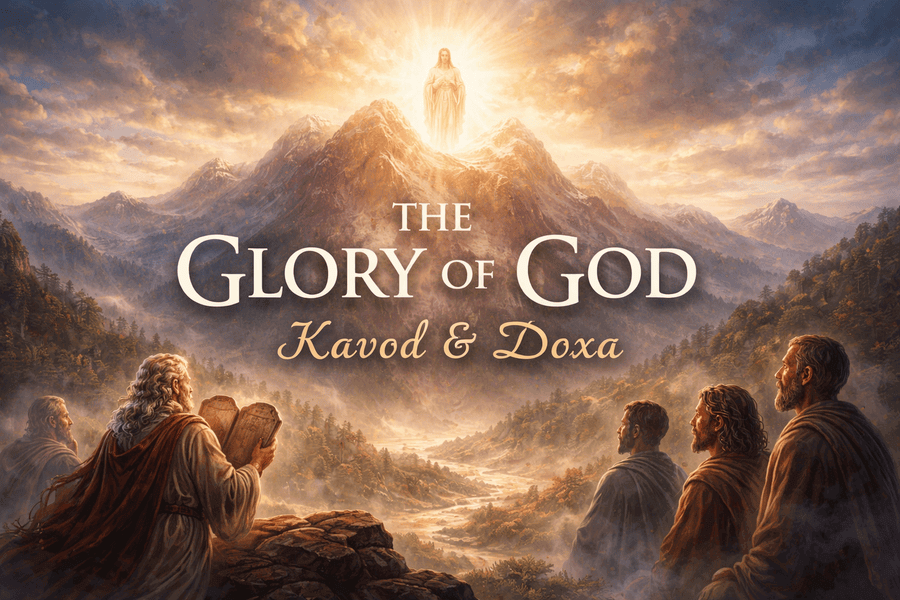
On Mount Sinai, Moses makes God a bold request:
“Please, show me Your glory.” — Exodus 33:18
What answer would you expect? A blazing fire? A display of heavenly armies? A terrifying power that would overwhelm the senses?
If I were Moses, I’d be expecting a moment of awestruck wonder—something like the Revelation Song describes:
“Clothed in rainbows of living color
Flashes of lightning, rolls of thunder
Blessing and honor, strength and glory and power”
But instead, God responds in the most unexpected way:
“I will make all My goodness pass before you, and I will proclaim the name of the LORD before you. I will be gracious to whom I will be gracious, and will show mercy on whom I will show mercy.” — Exodus 33:19 (LXX)
When Moses asked to see God’s glory, he was asking to see the substance of God Himself. What unfolded was not spectacle, but the unveiling of His character: good, gracious, and merciful.
And notice this crucial detail: “I will proclaim the name of the LORD [Yahweh].”
This carries a deeper message than we often realize.
The Name of God is I Am, and the name Jesus means I Am is Salvation. This connection will shine even brighter in the next chapter, when we see how God’s glory reveals more than majesty, dominion, and might.
This moment on Sinai becomes the foundation for how glory should be understood throughout the rest of Scripture. Every later vision of glory—whether Isaiah’s in the temple or John’s in Christ—flows from this same truth: to see God’s glory is to see His goodness revealed for the sake of His creation.

“The Whole Earth Is Full of His Glory”: Isaiah in the Temple
Centuries after Moses, another prophet is granted a vision of God’s glory. Isaiah writes:
“In the year that King Uzziah died I saw the Lord sitting upon a throne, high and lifted up; and the train of his robe filled the temple. Above him stood the seraphim… And one called to another and said: ‘Holy, holy, holy is the Lord of hosts; the whole earth is full of his glory!’” — Isaiah 6:1–3
Isaiah’s vision is breathtaking: the Lord enthroned in majesty, the temple shaken, the angels crying “holy, holy, holy.” It’s the kind of glory Moses might have expected to see.
Yet the angels declare something even greater: “The whole earth is full of his glory.”
Glory is not confined to the throne room.
It fills the world.
God’s presence and purpose are woven into creation itself.
Isaiah’s immediate response is one of trembling: “Woe is me! For I am lost; for I am a man of unclean lips.” (Isaiah 6:5)
In the presence of glory, human pride dissolves.
But God answers Isaiah’s despair with healing. A seraph touches his lips with a coal from the altar and says: “Your guilt is taken away, and your sin atoned for.”
Here, glory is revealed in forgiveness. The vision of majesty becomes a moment of cleansing and commissioning. Isaiah is not consumed by glory, he is purified and sent.
And John tells us what Isaiah truly saw: “Isaiah said these things because he saw his glory and spoke of him.” (John 12:41)
Isaiah’s vision was more than a glimpse of heaven. He was beholding Christ’s glory—the same goodness and mercy shown to Moses on Sinai, now filling the earth with God’s saving presence.
Luke’s Interpretation of Glory
When Isaiah declared, “The glory of the Lord shall be revealed, and all flesh shall see it together” (Isaiah 40:5), he spoke of a day when God’s majesty would break into history.
Centuries later, Luke quotes this same prophecy while telling of John the Baptist preparing the way for Christ. Yet he changes a single word that makes all the difference:
“And all flesh shall see the salvation of God.” — Luke 3:6
For Luke, God’s glory is salvation. What Isaiah foresaw as the glory of God filling the earth, Luke identifies plainly as God’s saving work in Christ.
This was not a slip of the pen, it was revelation.
Luke is telling us what the glory of God truly means when it arrives in Jesus: not a dazzling display to overwhelm humanity, but salvation that is good news to all people.
We see this again when Simeon holds the infant Christ in the temple:
“For my eyes have seen your salvation that you have prepared in the presence of all peoples, a light for revelation to the Gentiles, and for glory to your people Israel.” — Luke 2:30–32
Here, salvation and glory are joined as one reality, embodied in the person of Jesus.
In this light, Moses’ request to see God’s glory and Isaiah’s vision of glory filling the earth come into sharp focus. Luke interprets both: glory is not a distant majesty or a frightening power, but the goodness and mercy of God revealed as salvation for all flesh.
John and the Word Made Flesh
Moses saw glory as God’s goodness and mercy.
Isaiah saw glory filling the earth.
Luke revealed that glory is nothing less than salvation.
And then John takes us to the heart of it all:
“And the Word became flesh and dwelt among us, and we have seen his glory, glory as of the only Son from the Father, full of grace and truth.” — John 1:14
Here, glory is no longer a vision on a mountain or a prophecy to be fulfilled. Glory has stepped into history. It wears a human face.
John explains what this glory looks like: “full of grace and truth.”
- Grace — the overflowing goodness Moses heard proclaimed.
- Truth — the unveiling of God’s true character, longed for by prophets and poets, now revealed in Jesus.
He goes further: “For the law was given through Moses; grace and truth came through Jesus Christ.” (John 1:17)
The same God who revealed His Name on Sinai now shows that Name in flesh and blood.
And when John later reflects on Isaiah’s temple vision, he makes the connection explicit: “Isaiah said these things because he saw his glory and spoke of him.” (John 12:41)
To behold Jesus is to behold glory.
To hear His Name is to know that I Am is Salvation.
To follow Him is to walk in the same radiance that filled the temple and shook the mountain.
In Christ, all the threads come together.

The Glory of God Is His Revealed Identity
From Sinai to the temple, from the prophets to the Gospels, the story of God’s glory—”kabod”, the weight of all that He is—has been consistently revealed as His goodness (El Tov), mercy (El Rachum), salvation (Yeshua), and presence (Emmanuel).
- Moses heard glory proclaimed as goodness and compassion.
- Isaiah saw glory filling the whole earth.
- Luke interpreted glory as salvation for all flesh.
- John testified that glory became flesh and dwelt among us.
And Paul, writing to the Romans, circles us back to that defining moment with Moses:
“I will have mercy on whom I have mercy, and I will have compassion on whom I will have compassion.” — Romans 9:15, quoting Exodus 33:19
At first, those words might sound restrictive, as though God were narrowing His mercy to a chosen few. But Paul’s argument leads to the opposite conclusion:
“For God has consigned all to disobedience [or unfaithfulness], that He may have mercy on all.” — Romans 11:32
The glory Moses longed to see, the glory Isaiah declared filling the earth, the glory Luke identified as salvation, and the glory John beheld in Jesus—all of it culminates in this truth: God’s glory is His goodness, mercy, and salvation that covers the whole universe.
And this was always God’s plan. The prophet declared:
- “For the earth shall be filled with the knowledge of the glory of the Lord, as the waters cover the sea.” — Habakkuk 2:14
The whole earth is full of His glory, because the whole earth will see His salvation.
Isaiah’s vision of glory covering the world, joined with Luke’s declaration that all flesh will see God’s salvation, is nothing less than a prophecy of universal restoration.
If glory is the revealed identity of God made visible in Christ, then what does it mean that humanity has “fallen short of the glory of God”? Explore this further in Sin— Missing the Mark: What If Sin Isn’t About Behavior, But Being?
FAQs
What is God’s glory?
God’s glory is His goodness, mercy, and salvation that covers the whole universe.
What does the word Kabod mean?
The Hebrew word for glory, kabod, means weight, substance, and essence.
What does YHWH mean?
The Name of God is I Am, and the name Jesus means I Am is Salvation.