⚠️ Every post begins with a question and grows from my ongoing search to know God and understand His purpose for humanity. What you read here reflects my current view—born from study and wonder—and I often revisit and update my writings as I continue to learn and see more clearly.
“And God looked upon all that He had made, and indeed, it was very good.” – Genesis 1:31
In the beginning, Adam wasn’t a sinner in need of saving, he was the crowning expression of divine union. He was not flawed or lacking in anything – He was very good.
Formed from dust of the ground [earthily matter] and filled with the very breath of God, he was made in God’s image and entrusted with the care of a creation that flowed from divine goodness.
“The Spirit of God has made me, and the breath of the Almighty gives me life.” –Job 33:4
Adam wasn’t just with God—he was of Him. He lived, moved, and had his being in the Source of life itself. He bore God’s likeness, animated by His breath, and surrounded by the harmony of creation.
He lacked nothing… or so it seemed.
Ancient Jewish commentaries show that the “Fall” wasn’t about God’s wrath or a devil’s power—it was about trust broken, identity forgotten, and perception distorted.
Adam’s sin was not simply eating forbidden fruit—it was doubting his likeness to God, believing a voice that whispered “you are not enough.”
God’s response was not to destroy, but to pursue, cover, and begin the long path of restoration.
Two Stories, One Creation
At first glance, Genesis seems to tell two different stories about creation. But ancient Jewish teachers didn’t see a contradiction, they saw two layers of the same beautiful truth.
- Genesis 1: The Cosmic Blueprint
Genesis 1 is wide and majestic. God (called Elohim here) speaks the universe into existence, day by day, in perfect order.
Humans are created last, like the grand finale:
“Let us make man in our image, after our likeness…” – Genesis 1:26
Here, “man” (Hebrew: adam) refers to all humanity, male and female together (v. 27). They are made in God’s image, equal in worth and spiritual identity.
- Genesis 2: The Close-Up
“then the Yahweh Elohim formed the man of dust from the ground and breathed into his nostrils the breath of life, and the man became a living creature. – Genesis 2:27
Genesis chapter 2 zooms in like a camera moving from the stars to the soil.
God is now called Yahweh Elohim (often rendered as Lord God), a more personal name– and He doesn’t just speak things into existence; He forms [“formed” in Genesis 2:7 is יֵצֶר (yatsar), a verb used for a potter shaping clay].
He shapes Adam from the dust, then breathes His own breath into him.
- Earthily Yet Divine
Ancient Jewish commentary (such as the Midrash) adds that Adam was formed from dust gathered from every corner of the earth, symbolizing his role as a microcosm of creation representing the whole cosmos.
His body came from below, but his breath came from above—a union of earth and heaven, humility and glory. This mirrors the incarnation of Jesus, the Last Adam, who embodied both dust and divinity.
Paul echoes this mystery in 2 Corinthians 4:7:
“But we have this treasure in jars of clay, to show that the surpassing power belongs to God and not to us.”
Adam’s Role: King, Priest, Mirror of the Divine
Adam’s purpose wasn’t merely to exist in paradise, but to reflect, represent, and steward the divine presence on Earth.
- He was a son of God. Luke 3:38 confirmed his divine sonship—a familial relationship with God.
- He was a priest in God’s temple (the Garden). Adam is placed in a garden, not just to enjoy it, but to cultivate and protect it. The Hebrew words avad (work) and shamar (keep) are the same words later used for priests serving in the temple. In other words, Adam’s first job was sacred.
- He was a king—given dominion over creation. The Hebrew verbs used in Genesis 2:15 “to dress” (עָבַד, avad) the same used in Levitical priestly duties (cf. Numbers 3:7–8; 8:26). Adam was a priest-king, meant to guard sacred space, tend creation, and represent divine order.
Philo of Alexandria (1st century BC) saw Adam as the Logos-made-human—reason and order embodied, a bridge between heaven and earth.
The Real Fall: Identity Crisis
Ancient Jewish thought doesn’t focus on original sin as a transmitted curse, but rather on the psychological and spiritual shift that took place in Adam and Eve’s perception:
- Before the Fall: They were ‘arom (naked) but unselfconscious.
- After the whisper “You will be like God”: They questioned their own identity.
- After the bite: Their eyes were opened to shame and fear. They covered themselves and hid, suggesting a change in how they saw themselves, God, and each other.
Rashi, the great 11th-century Jewish commentator, taught that the ‘serpent’ didn’t force them to sin—he merely planted doubt in God’s goodness and intentions.
The Birth of Lies
In several ancient Jewish commentaries, the serpent is seen not merely as a literal creature, but as a symbol of internal deception—a whisper of confusion arising from within, suggesting that God’s love isn’t enough, and we are not enough.
Despite bearing God’s image, filled with His breath, and entrusted with all His creation, Adam began to believe a lie: That he was lacking, disconnected, and incomplete.
“If I have concealed my transgressions [pesha] as Adam…” — Job 31:33
✱ Pesha in Hebrew refers to deliberate rebellion, a willful turning of the heart rooted in a distorted view of self and of God’s character. This internal pesha—this hidden mistrust—may have been the very crack that let the serpent’s whisper in.
Two lies were planted:
- “You will not surely die” — casting suspicion on God’s honesty
- “You will be like God” — implying they were not already like Him
This was not just an intellectual deception—it became a relational rupture. Not from God’s side, but from humanity’s perception.
The Real Meaning of the Word Sin
Over time, as doctrines developed and interpretations were handed down through the Latin Church (especially in the West) the meaning of sin became distorted by assumptions far removed from the original text.
We inherited a version of Scriptures that equates sin with “breaking rules” or “failing to be perfect.” So we throw around verses like “for all have sinned and fall short of the glory of God” and “be holy as I am holy” that only reinforce the idea that sin is falling short of God’s unreachable standard.
But when we step back and explore the original Hebrew and Greek words, that rigid interpretation starts to fall apart.
Hebrew Words for Sin
- Chatta’ah — “to miss the way”
- Pesha‘ — “rebellion” or “betrayal”
- ‘Avon — “distortion” or “crookedness”
These point to a relational break, not a perfection or legal one.
To ancient Israel, sin was not about failing to be impeccable (from the Latin impeccabilis — “without sin or fault”)—it’s about being lost, either by rebellion or deception.
The Greek Word: Hamartia
While often rendered as “missing the mark,” the meaning of the word translated as sin—hamartia—reaches far beyond that.
Many scholars suggest it derives from two roots:
- ha- — a negation prefix (like dis-), meaning not or without
- -martia — linked to meros, meaning “portion,” “origin,” or “inheritance”
So hamartia may be better understood as: “without one’s portion,” or “disconnected from origin”
Sin, then, is not just wrongdoing, it’s identity amnesia.
It is forgetting who we are, where we came from, and who we belong to. Freedom from sin begins not with striving to obey, but with awakening to your true origin. Sin loses power not when we try harder, but when we see clearer.
Want to explore the original meaning of sin? Read “Missing the Mark”.
The Delusion of Separation
Far from wrath or rejection, Scripture reveals God’s immediate response as mercy, tenderness, and pursuit.
“Where are you?” — Genesis 3:9
God wasn’t confused, He was calling Adam out of hiding. Love doesn’t abandon, it seeks (Luke 19:10)
Before Adam and Eve even asked, God clothed them:
“And the LORD God made for Adam and for his wife garments of skins and clothed them.” — Genesis 3:21
A foreshadowing of Christ’s self-giving love, it prefigures His covenant promise:
“I spread the corner of my garment over you and covered your nakedness; I made my vow to you and entered into a covenant with you… and you became mine.” — Ezekiel 16:8
Even the banishment from Eden was not divine rejection but divine protection:
“…lest he… take also of the tree of life and eat, and live forever…” — Genesis 3:22
To eat of the Tree of Life in a fragmented state would’ve sealed humanity in delusion. The flaming sword didn’t guard Eden in wrath, it guarded hope, awaiting the One who would reopen the way (Matthew 27:51).
The story of the fall is not the story of God turning from humanity, but of humanity turning inward and God drawing near anyway.
Unpacking the Separation Narrative
Many Christians quote Isaiah 59:2 to say sin separates us from God:
“Your iniquities have separated you from your God…”
But is this literal separation? Or perception?
Long before Isaiah, God had already said:
“I will never leave you nor forsake you.” — Deuteronomy 31:6
The context of Isaiah matters: Israel was deep in injustice. Their sin clouded their awareness, not God’s faithfulness.
Habakkuk echoes the same reality vs. human perception:
“Your eyes are too pure to look on evil…” — Habakkuk 1:13
“…Yet why do You look on those who deal treacherously?” — Habakkuk 1:14
Paul stated:
“And you, who once were alienated and hostile in mind…”— Colossians 1:21
Again—the alienation was never from God’s side, it’s a human perspective.
We cannot separate from the One who upholds us:
- Colossians 1:17 — “He is before all things, and in him all things hold together.”
- Acts 17:28 — “For in him we live, and move, and have our being…”
(“our being” — ἐσμέν, we are, present plural of to be) - 1 Corinthians 8:6 — “…one God, the Father, from whom all things came and for whom we exist.”
- Ephesians 4:10 — “The very One who ascended above all the heavens, in order to fill all things.”
- Romans 11:36 — “For from Him and through Him and to Him are all things…”
Nothing can separate us
“For I am sure that neither death nor life, nor angels nor rulers, nor things present nor things to come, nor powers, nor height nor depth, nor anything else in all creation, will be able to separate us from the love of God in Christ Jesus our Lord.” — Romans 8:28-39
Let’s walk through Paul’s powerful declaration and dismantle the illusion of separation, piece by piece:
- Neither death nor life
Not even the finality of death—or the complexity of this life—can undo your union with God. This debunks the idea that we only get “one shot” at being “saved”. - Neither angels nor rulers
No false messengers, not even the “ruler of this world” (already judged—John 16:11), have power to stand between us and God. - Neither things present nor things to come
Every event, every mistake, every moment—past, present, or future—has already been accounted for. Nothing surprises God, and nothing severs His love. - Nor powers
Even sin, personified in Scripture as a master, has been dethroned. It holds no power to separate us from our Creator. - Neither height nor depth
Whether you’re on a mountaintop or in the valley, in joy or despair, in “Heaven” or your idea of “Hell,” nothing can outdistance you from His love.
Nor anything else in all creation
And just to be absolutely clear: not even you — with your sin, rebellion, rejection, blindness, broken choices, evil deeds, or self‑inflicted exile — can break the bond.
God guaranteed this when He was in Christ, reconciling the world to Himself, not counting our sins against us (2 Corinthians 5:19).
Curious about who’s included in Christ? Don’t miss “Who Is In Christ?”
Jesus Crossed Every Boundary Separation Claims
And if you still wonder we could ever be separated from God, just look at Jesus.
He didn’t flee sin, He invaded it:
He Touched the Untouchable: Matthew 8:3; Matthew 9:25
He Ate with Sinners and Outcasts: Matthew 9:11; Luke 7:34
Jesus Let the Broken Touch Him: Luke 7:37–38; Matthew 9:21
If sin truly separated us from God, Jesus would have kept His distance, but instead, He moved closer every time. In Jesus, the myth of separation collapses, because God’s love always moves toward, never away.
“God refuses to let go of the very ones He loves, and His redemptive work extends beyond what we assume possible.”
C. Baxter Krueger
“My God, Why Have You Forsaken Me?”
“God was in Christ, reconciling the world unto Himself…” — 2 Corinthians 5:19
So how could He suddenly forsake His Son? He didn’t.
Jesus made this union unmistakable:
“I and the Father are one.” — John 10:30
“I am not alone, for the Father is with me.” — John 16:32
“The Father is in me, and I in the Father.” — John 10:38
From His birth in a lowly manger to His final breath on the cross, Jesus embraced the totality of human suffering.
He experienced temptation in the wilderness (Matthew 4:1–11)—a confrontation not only with appetite, pride, and power, but with the ancient serpent who whispers the same lie: “If you are the Son of God…”.
Jesus, unlike Adam, never doubted His belovedness.
He faced hunger (Matthew 4:2), thirst (John 19:28), and fatigue (John 4:6). He was misunderstood by His own family (Mark 3:21), grieved deeply over death and loss (John 11:33–35), and sorrowed to the point of death in Gethsemane (Matthew 26:38).
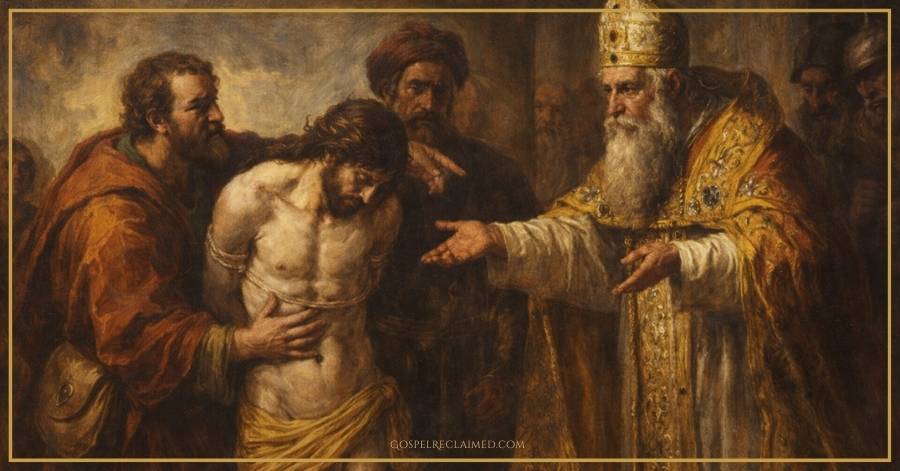
He was betrayed by a friend (Luke 22:47–48), abandoned by His disciples (Matthew 26:56), falsely accused (Mark 14:55–59), mocked and tortured (Matthew 27:27–31), stripped naked (John 19:23–24), and hung exposed to shame (Hebrews 12:2).
In that garden, He cried out for another way, yet surrendered fully: “Not My will, but Yours be done.” (Luke 22:42). His trust never wavered.
And at His lowest moment, He took upon Himself the cry of our abandonment:
“My God, My God, why hast Thou forsaken Me?” — Matthew 27:46
This wasn’t a declaration of doubt, it was the cry of every human heart that’s ever felt alone. Jesus entered even our illusion of separation to shatter its lies from within.
And the people present at the crucifixion knew which song he was actually quoting (Psalm 22) a song that begins in despair and ends in triumph.
“For He has not despised nor abhorred the affliction of the afflicted; Nor has He hidden His face from Him; But when He cried to Him, He heard.” — Psalm 22:24
Yet even then, He never lost hold of the truth. His final words were full of trust and belonging.
Notice that in that moment of agony, He cried out, “My God, My God…”—not “Father.”
In doing so, He was identifying fully with our disoriented human state, our sense of abandonment, confusion, and alienation.
But just moments later, He returns to intimacy:
“Father, into Thy hands I commit My spirit.” — Luke 23:46
He never stopped trusting the Father’s love.
The union between Father and Son was never severed—not even in suffering.
It was carried through the Cross, undiminished.
All the ends of the earth shall remember
“All the ends of the earth shall remember and turn unto the Lord: and all the kindreds of the nations shall worship before thee.” — Psalm 22:27
Here lies our hope: Scripture overflows with promises that all humanity will one day awaken to their true identity, remember to whom they belong, return, and call upon the Lord our Savior. 👉 1
If we start the Gospel with separation, everything becomes damage control.
But if we begin with union, everything becomes restoration.
You’re not striving to earn your place.
You’re awakening to where you’ve always belonged.
“He is before all things, and by him all things consist.” — Colossians 1:17
So this week, pause.
Recall a moment when you felt far from God.
Then speak this over your soul:
“I was never separated.”
Let that truth settle deep in your being.
You are not merely with God.
You are of God.
You always have been.
And you always will be.
Now, rest, and live from this truth.
Let it reshape everything you think, say, and do.
FAQs
Can sin separate me from God?
No. Sin distorts our perception of God, but it doesn’t undo our union with Him. Scripture teaches that we live, move, and have our being in Him (Acts 17:28), and nothing in all creation can separate us from His love (Romans 8:38–39). The sense of separation is a human illusion—God has never turned away.
What does the Bible really say sin is?
Sin is identity amnesia. Rather than “breaking rules,” the original Hebrew and Greek words reveal sin as missing the way (chatta’ah), distortion (‘avon), or forgetting your origin (hamartia). It’s not legal guilt but a relational disconnection in our perception. Sin is forgetting we are made in God’s image, filled with His breath.
Was Jesus really forsaken by God on the cross?
No, He wasn’t. Jesus quoted Psalm 22: “My God, my God, why have You forsaken Me?”—a cry of human anguish, not divine abandonment. Psalm 22 ends in hope: “He has not hidden His face from Him” (v.24). Jesus never lost trust in the Father: “Into Your hands I commit My spirit” (Luke 23:46).
Footnote:
- Isaiah 45:22–23
“Turn to me and be saved, all the ends of the earth! For I am God, and there is no other. By myself I have sworn; from my mouth has gone out in righteousness a word that shall not return: ‘To me every knee shall bow, every tongue shall swear allegiance.’”
Isaiah 66:23
“From new moon to new moon, and from Sabbath to Sabbath, all flesh shall come to worship before me, declares the Lord.”
Revelation 15:4
“Who will not fear, O Lord, and glorify your name? For you alone are holy. All nations will come and worship you, for your righteous acts have been revealed.”
Isaiah 2:2–3
“It shall come to pass in the latter days that the mountain of the house of the Lord shall be established as the highest of the mountains, and shall be lifted up above the hills; and all the nations shall flow to it,
and many peoples shall come, and say: ‘Come, let us go up to the mountain of the Lord, to the house of the God of Jacob, that he may teach us his ways and that we may walk in his paths.’ For out of Zion shall go the law, and the word of the Lord from Jerusalem.”
↩︎