⚠️ Every post begins with a question and grows from my ongoing search to know God and understand His purpose for humanity. What you read here reflects my current view—born from study and wonder—and I often revisit and update my writings as I continue to learn and see more clearly.
And This is Eternal Life…
Many of us grow up hearing about eternal life in church, yet very few are ever told what it actually means. The phrase is repeated constantly, but rarely explained, leaving believers with a shallow and incomplete understanding of the Christian life.
Without knowing what the words ‘eternal life’ (Greek: zoē aiōnios) is, we miss out on joy, peace, and rest—the very essence of the Gospel.
In the teaching that inspired this post, “What Is Eternal Life?”, Malcolm Smith uses gentle humor to question familiar ideas of heaven: mansions, reunions with loved ones, or an unending church service.
Is that really what Jesus died for? An unending praise session where God sits as the ultimate narcissist?
Absolutely not.
The biggest problem? The word “eternal” itself.
In English, it conjures images of endless time, something that starts after death or at Jesus’ return. Evangelism often hinges on questions like, “Where will you spend eternity?” or “If you died tonight, where would you go?”
This frames Christianity as an “afterlife insurance policy,” leaving us wondering how to live meaningfully now.
But Smith exposes something vital: that idea did not come from Jesus.
When Jesus speaks of eternal life, He does not point to the afterlife. He defines it plainly and directly:
“And this is eternal life, that they may know You, the only true God, and Jesus Christ whom You have sent.” —John 17:3
That verse is the only direct definition of eternal life in Scripture, and it is neither poetic nor symbolic. It describes not head knowledge, but intimate, relational knowing, the kind of knowing Scripture uses for marriage.
Eternal life is not living forever. It is knowing by experience, relationship, and participation. If eternal life were mainly about what happens after death, Jesus’ definition would make little sense.
That alone should cause us to pause and reconsider everything we were taught.
Why “Eternal” Is a Bad Translation
One of the most important points Malcolm makes—and one the Church desperately needs to recover—is this: the word eternal is a deeply misleading translation.
The Greek word is aiōnios, from aiōn. It does not mean endless time. It means an age, or a quality of life belonging to an age.
Aiōn can refer to:
1. A Human Lifetime
Here, aiōn refers simply to the span of a human life—neither short nor infinite, just a measured season.
My aiōn right now is 45.
2. A Mosquito’s Life
This example shows that aiōn does not imply length—only a duration appropriate to the subject.
A mosquito’s aiōn is a few days.
3. The Age of a Tree
Again, this reinforces that aiōn simply means a span of existence, whether short or long.
Trees last for hundreds of aiōns.
4. God’s Life — “Ages of Ages”
When aiōn is used of God, Scripture employs a plural intensification:
The ages of ages.
This does not introduce a different word meaning “eternity,” but rather points to:
- Age upon age
- Life extending beyond all visible horizons
- Looking backward and forward to the vanishing point
This is still not a philosophical abstraction of endless time, but life without boundary because it is God’s life.
5. The Messianic Age
This was Malcolm’s most important theological example. He explained that first-century Jews spoke of a distinct and anticipated period he described as:
“That unique age — the age of Messiah.”
This aiōn referred not to the afterlife, but to a new kind of life breaking into history—God’s life arriving within human time, heaven coming to earth, and humanity living from a reality it had never known before.
““The earth shall be full of the knowledge of the LORD, as the waters cover the sea.” –Isaiah 11:9
“I will put my spirit in you, and ye shall live.” –Ezekiel 37:14
“A new heart also will I give you, and a new spirit will I put within you.” – Ezekiel 36:26
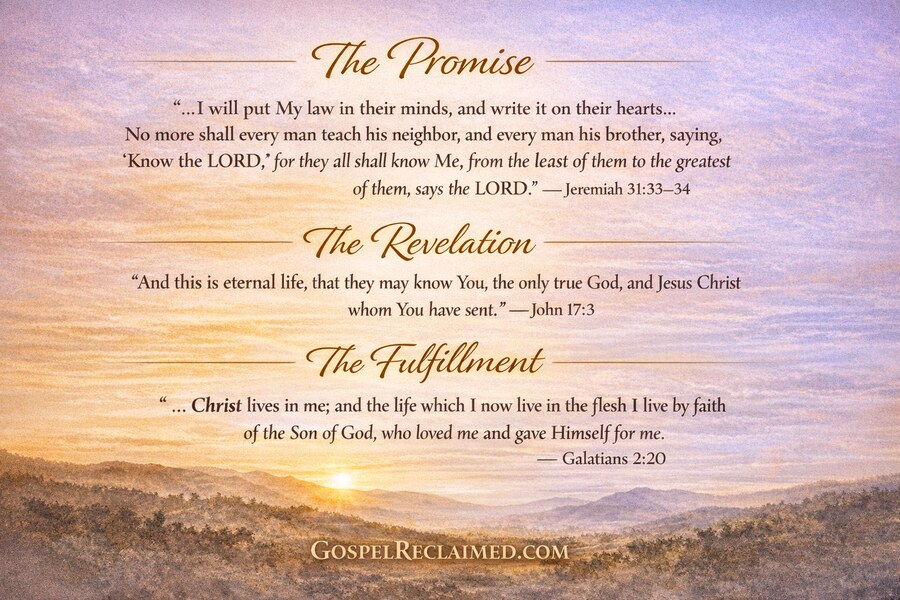
In the New Testament world, people were not waiting for “forever.” They were waiting for the age of Messiah foretold by the prophets—the age when God’s life would break into human life, and heaven and earth would overlap.
That is the age Jesus announced.
So aiōnios life is not “life that never ends.”
It is the life of God belonging to the age of God, invading the present moment.
This explains why Jesus constantly spoke in present tense:
“He that believeth on me hath everlasting life.” —John 6:47
“Verily, verily, I say unto you, He that heareth my word, and believeth on him that sent me, hath everlasting life…” —John 6:47
Not will have.
Has.
The tragedy is that by translating aiōnios as “eternal,” Christianity was slowly shifted into an afterlife religion—one that postponed life instead of receiving it now.
The Life We Have vs. the Life Jesus Brought
The New Testament makes a crucial distinction: not all “life” is the same.
There is bios—biological existence. We breathe, think, work, age, and eventually die. This is ordinary human life.
But Jesus came speaking about zoē. Zoē is God’s own life, a life that does not merely outlast death but actively contradicts it.
As John writes:
“In him was life (zoē); and the life was the light of men.” —John 1:4
Jesus does not say He gives bios that goes on forever.
He says He brings zoē into human existence.
This is the life He promises:
“I am come that they might have life, and that they might have it more abundantly.” —John 10:10
Smith describes this as a “blessed invasion”, God’s undying life entering our time-bound existence, confronting death at every level.
This zoē life does not begin after death. It is lived as we participate in the life Christ has already given us—the fulfillment of Israel’s hope: Messiah bringing heaven to earth.
In John 4, Jesus offers the Samaritan woman living water (zoē water) that becomes a spring welling up to aiōn life. Not future hydration, but God’s life bubbling up within her now:
“If thou knewest the gift of God… thou wouldest have asked of him, and he would have given thee living water… the water that I shall give him shall be in him a well of water springing up into everlasting life (zoē aiōnios).” —John 4:10, 14
Later, Jesus calls Himself the Bread of Life. To eat this bread is not to gain endless existence, but to participate in His life:
“For the bread of God is he which cometh down from heaven, and giveth life unto the world.” —John 6:33
Zoē Life does not begin after you die.
It is known and lived in relationship with the Father and the Son.
This is why eternal life is not about escaping death someday.
It is about death being undone now.
Eternal Life Is Not Something You Receive — It Is Someone You Share
One of the most liberating truths is this: Jesus does not give eternal life as a thing. He does not hand you a spiritual object and walk away.
He said: “I am the life.” —John 14:6
Zoē life is personal.
Zoē life is relational.
Zoē life is shared.
Eternal life isn’t a post-death bonus; it’s God’s life invading yours today, transforming ordinary bios into extraordinary zoē.
His life frees us from anxiety and performance. There’s no more “trying to get there” because Christ has done it all. Our actions spring from rest, not effort. If we’re still striving, we haven’t entered this rest.
Daily Bible reading, prayer, and church attendance as “must-dos” to stay in good standing. Instead, they’re expressions of the zoē life already within us. Ignorance of this cripples believers, leaving vast areas of joy and peace unexplored.
That is why the New Testament language is not “try to live like Christ,” but known phrases like:
“Christ liveth in me.” —Galatians 2:20
This changes everything.
If zoē life were something you had to maintain, then Christianity would be anxiety-driven.
If zoē life depended on your effort, you would constantly fear losing it.
But if life is His zoē shared with you, then the Christian life is not self-effort—it is participation.
Malcolm uses the image of a baby in the womb: the child lives by the mother’s life, yet it is truly living. That is not passivity, it is dependence.
And that is exactly how Scripture describes faith.
Faith Is Not Believing Information — It Is Resting in Reality
One of the most damaging misunderstandings in Christianity is the idea that faith means mentally agreeing with correct doctrine. Scripture never defines believing as intellectual, doctrinal agreement.
Biblical faith is not about holding the right ideas, it is about “believing into” Jesus, a living union in which we abide in Him and He abides in us (John 15:4–5).
This is exactly where Jesus’ prayer in John 17 leads. He does not pray for better belief systems, but for oneness, that believers would be united with one another and with God, just as the Father and the Son are one (John 17:20–23).
Zoē aiōnios (eternal life), then, is not a reward for correct thinking; it is this shared divine life, drawing us into God’s own fellowship and making us partakers of the divine nature (2 Peter 1:4).
Malcolm cuts straight through the illusion.
Biblical faith is not believing facts to be true. It is active reliance—placing the full weight of your life on what already is. That is why Hebrews says something so striking:
“Let us labour therefore to enter into that rest.” —Hebrews 4:11
The only labor is ceasing to strive.
Faith is not forcing yourself to believe harder. It is discovering that you are already held. This is why Jesus never pressured people to “decide quickly” or sign onto a system. He invited them to come and abide, to drink, to receive, and to rest (John 15:4–5; John 4:10–14; Matthew 11:28).
The kingdom life Jesus gives is not frantic, fearful, or performance-based. It is the restful life of God lived in human form—Christ sharing His own life with us here and now.
Embrace the Age of Messiah
Malcolm Smith’s teaching reminds us that eternal life is far richer than endless existence—it is knowing God intimately and living His undying life now. It shifts our focus from afterlife speculation to present-tense union with Christ. If you’ve viewed Christianity as a moral code or a ticket to heaven, this perspective may quietly and powerfully revolutionize your faith.
Malcolm’s message is simple, yet paradigm-shifting.
Eternal life is not about living forever someday somewhere else.
It is God’s own life shared with humanity now.
It is the life of the age of Messiah.
It looks like trust instead of striving, rest instead of anxiety, participation instead of imitation.
“This is the record, that God hath given to us eternal life, and this life is in his Son.” (1 John 5:11)
Not will give.
Has given.
The Gospel is not about escaping the world.
It is about heaven invading earth through Christ in us.
“the kingdom of God is within you.” —Luke 17:21
So don’t wait for eternal life, step into it, drink deeply, and enjoy the freedom, rest, and fullness of the kingdom life Jesus came to give here and now.
That is eternal life.
For the full depth of this message, in Malcolm Smith’s warm and conversational style, watch the webinar below—it’s an hour well spent.
FAQs
What does “eternal life” really mean in the Bible?
In the Bible, eternal life doesn’t mean living forever after death. It means sharing in God’s own life (zoē) now—the life of the age of Messiah, lived in relationship with Him.
Does eternal life begin after we die or now?
According to Jesus, eternal life begins now. He said, “This is eternal life, that they may know You” (John 17:3). It’s a present experience, not a future reward.
What is the difference between bios and zoē?
Bios is natural, biological life that ages and dies. Zoē is God’s own life—indestructible, abundant, and shared with us through Christ.