⚠️ Every post begins with a question and grows from my ongoing search to know God and understand His purpose for humanity. What you read here reflects my current view—born from study and wonder—and I often revisit and update my writings as I continue to learn and see more clearly.
Before asking what “hell” means, we need to ask a more basic question:
Which Hebrew or Greek Word Was Translated as “Hell”?
This study uses the King James Version as its foundation—not because the KJV is the only trustworthy translation, but because few English Bibles have exercised greater influence over Christian language, preaching, doctrine, and imagination.
For centuries, its vocabulary shaped how English-speaking Christians understood Scripture. Its translation choices influenced later English Bibles and, through English-speaking churches and missionary movements, helped shape Christian terminology in other languages as well.
The KJV is particularly important to this study because it translated a wider range of original Hebrew and Greek words as “hell” than most modern translations. Words describing the grave, the realm of the dead, a geographical valley outside Jerusalem, and the confinement of rebellious angels were all placed beneath the same English label.
When readers encountered “hell” repeatedly, it naturally appeared that every passage referred to the same place. Over time, these separate biblical images blended into one terrifying doctrine: an otherworldly chamber where human beings would remain conscious in torment forever.
This study has a specific and limited purpose. It is not intended to explore the entire historical development of hell, explain every judgment passage, or examine related images such as the lake of fire, outer darkness, everlasting fire, or the bottomless pit.
For a deeper journey through the history of the concept—its Hebrew and Greek background, prophetic context, translation history, and eventual development into the doctrine of eternal conscious torment—read HELL — The Real Story.
Here, our focus will remain on the words themselves:
- Which original words did the KJV translate as “hell”?
- Where does each one appear?
- What did each word mean in its original biblical and historical context?
- Did any of them actually describe eternal conscious torment?
One English Word—Three Different Greek Terms
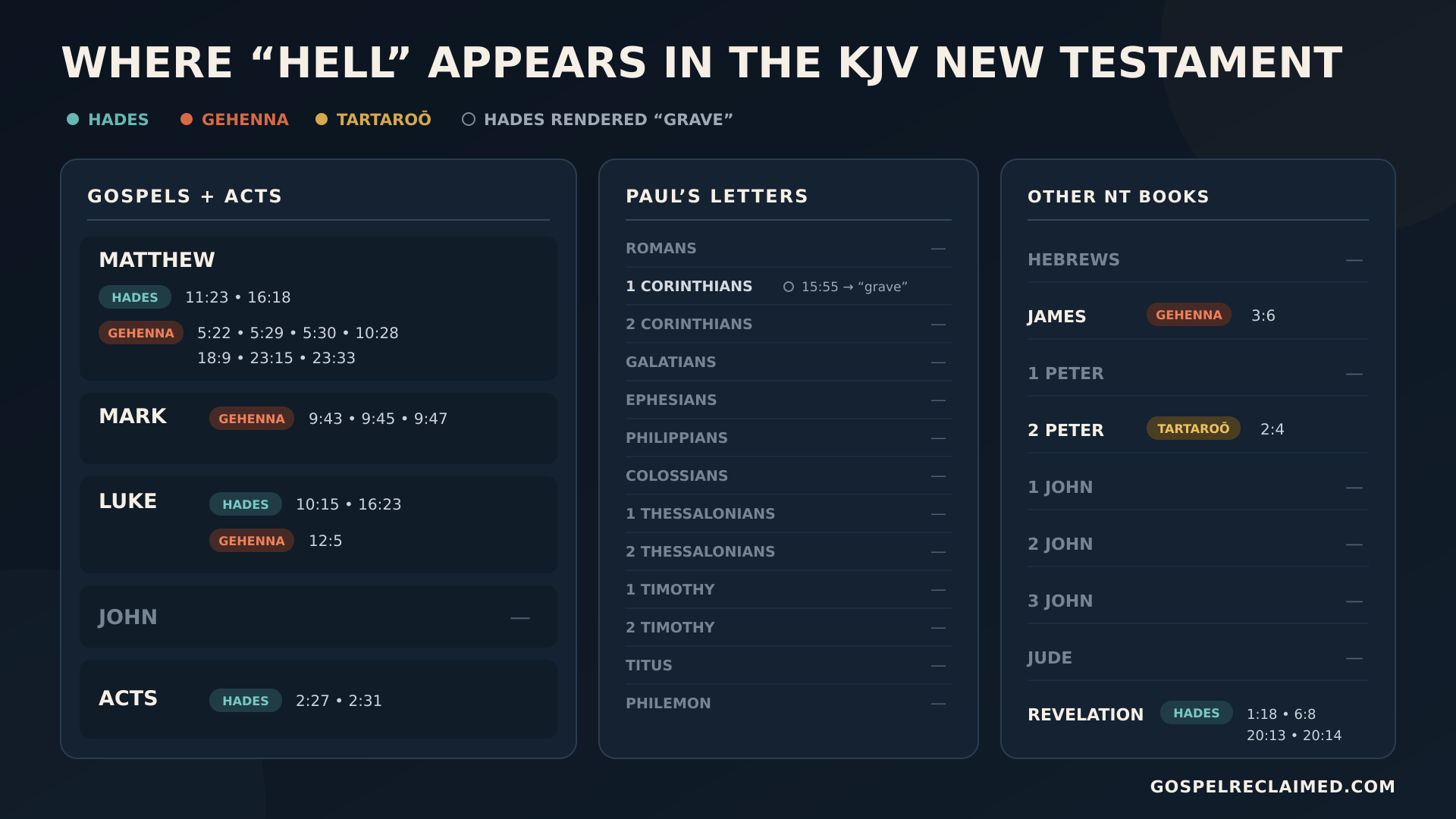
The KJV uses the word “hell” 23 times in the New Testament—more often in Matthew than in any other book—to translate three distinct Greek terms: Hades, Gehenna, and tartaroō. Read in English, these passages can appear to describe a single place: a fiery realm of punishment awaiting people after death.
Yet these three terms are not interchangeable. They differ in origin, meaning, and application.
| Original term | Occurrences relevant to the KJV | KJV rendering |
| Hades — ᾅδης | 11 | “Hell” ten times and “grave” once |
| Gehenna — γέεννα | 12 | “Hell” or “hell fire” |
| Tartaroō — ταρταρόω | 1 | “Cast down to hell” |
| Total | 24 | The English word “hell” appears 23 times |
🚨 The additional occurrence is 1 Corinthians 15:55, where the Greek text underlying the KJV uses Hades, but the translators rendered it “grave” rather than “hell.”
Before examining them, however, we must begin with the Hebrew Scriptures—because that is where the biblical understanding of death begins.
Sheol — The Silent Realm of Death
The Hebrew word Sheol (שְׁאוֹל) is frequently translated as “hell” in the Old Testament, but it was never presented in the Hebrew Scriptures as a place of eternal conscious torment. Sheol was the grave—the dark, silent realm of death to which humanity descended.
David trusted that God would not abandon him there:
“For thou wilt not leave my soul in hell [Sheol]; neither wilt thou suffer thine Holy One to see corruption.” — Psalm 16:10 KJV
He also praised God for delivering his soul from Sheol:
“For great is thy mercy toward me: and thou hast delivered my soul from the lowest hell [Sheol].” — Psalm 86:13 KJV
Jacob expected to go to Sheol while mourning Joseph:
“For I will go down into the grave [Sheol] unto my son mourning.” — Genesis 37:35 KJV
Jacob did not believe he was going to a place of punishment. He believed he would join his son in death.
Job asked God to hide him in Sheol until His anger had passed:
“O that thou wouldest hide me in the grave [Sheol], that thou wouldest keep me secret, until thy wrath be past.” — Job 14:13 KJV
Ecclesiastes describes Sheol as a condition without earthly activity, knowledge, or work:
“There is no work, nor device, nor knowledge, nor wisdom, in the grave [Sheol], whither thou goest.” — Ecclesiastes 9:10 KJV
Even Jonah cried “out of the belly of hell [Sheol]” while trapped inside the fish (Jonah 2:2).
Jonah was not being tortured in an afterlife prison. He used Sheol as the language of death and the grave because he believed he was about to die.
The KJV translated the same Hebrew word as “hell,” “grave,” or “pit,” depending on the passage. This inconsistent translation concealed the fact that the same realm of death was being described.
🚩 When righteous people entered Sheol, translators often called it “the grave.” When the wicked entered Sheol, they frequently called it “hell.”
The Hebrew text makes no such distinction. Sheol was the realm of the dead, not the eternal destination of condemned souls, much less a place of everlasting torment.
This matters because the New Testament did not introduce the doctrine of hell; it inherited the language and concept of Sheol.
Hades — The Realm of The Dead
When the Hebrew Scriptures were translated into Greek, Hades (ᾅδης) became the usual Septuagint equivalent of Sheol.
The connection is made unmistakably in Acts 2:27, where Peter quotes Psalm 16:10:
“Because thou wilt not leave my soul in hell [Hades], neither wilt thou suffer thine Holy One to see corruption.” — Acts 2:27 KJV
Psalm 16 uses the Hebrew word Sheol. Acts uses the Greek word Hades. Peter was speaking about Christ’s death and resurrection, not His rescue from an eternal torture chamber.
Hades, like Sheol, refers to the realm or state of the dead. It is not “hell,” it does not denote endless torment, and it is not humanity’s final destination.
Every Occurrence of Hades in the KJV
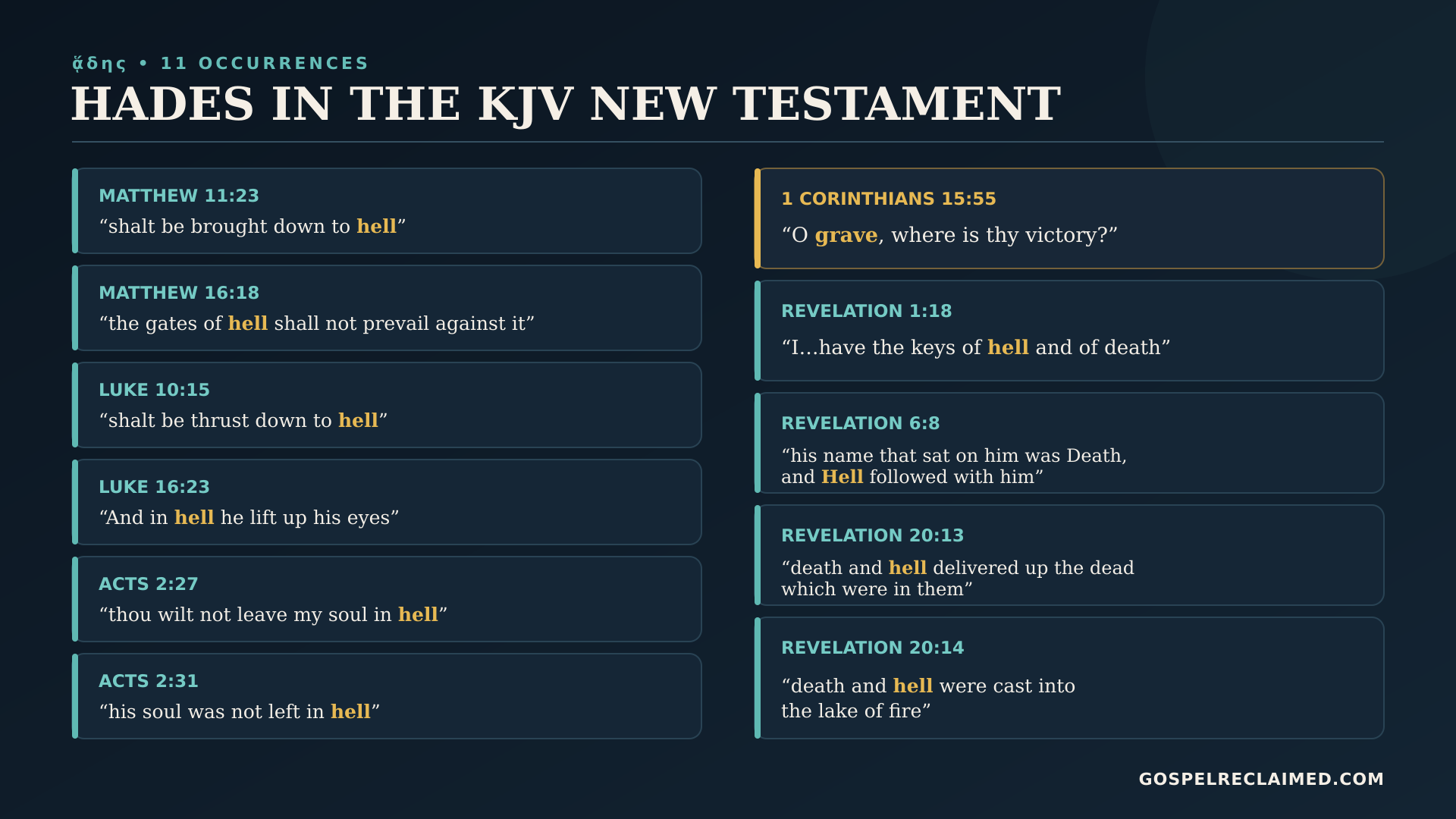
- Matthew 11:23 — “And thou, Capernaum, which art exalted unto heaven, shalt be brought down to hell [Hades]: for if the mighty works, which have been done in thee, had been done in Sodom, it would have remained until this day.”
- Matthew 16:18 — “And I say also unto thee, That thou art Peter, and upon this rock I will build my church; and the gates of hell [Hades] shall not prevail against it.”
- Luke 10:15 — “And thou, Capernaum, which art exalted to heaven, shalt be thrust down to Hades.”
- Luke 16:23 — “And in hell [Hades] he lift up his eyes, being in torments, and seeth Abraham afar off, and Lazarus in his bosom.”
- Acts 2:27 — “Because thou wilt not leave my soul in hell [Hades], neither wilt thou suffer thine Holy One to see corruption.”
- Acts 2:31 — “He seeing this before spake of the resurrection of Christ, that his soul was not left in hell [Hades], neither his flesh did see corruption.”
- 1 Corinthians 15:55 — “O death, where is thy sting? O Grave [Hades] , where is thy victory?”
- Revelation 1:18 — “I am he that liveth, and was dead; and, behold, I am alive for evermore, Amen; and have the keys of hell [Hades] and of death.”
- Revelation 6:8 — “And I looked, and behold a pale horse: and his name that sat on him was Death, and Hades followed with him. And power was given unto them over the fourth part of the earth, to kill with sword, and with hunger, and with death, and with the beasts of the earth.”
- Revelation 20:13 — “And the sea gave up the dead which were in it; and death and Hell [Hades] delivered up the dead which were in them: and they were judged every man according to their works.”
- Revelation 20:14 — “And death and hell [Hades] were cast into the lake of fire. This is the second death.”
🏆 The final passages make the nature and destiny of Hades especially clear:
- Jesus entered Hades but was not left there (Acts 2:27, 31).
- Christ possesses its keys (Revelation 1:18).
- Hades must release every dead person within it (Revelation 20:13).
- Hades itself is cast into the lake of fire (Revelation 20:14).
- Paul announces victory over it (1 Corinthians 15:55).
👉 An eternal destination could not surrender its inhabitants and then be destroyed. Hades represents the reign of death—and Christ came to defeat death itself.
The “gates of Hades” in Matthew 16:18 therefore do not describe demonic armies emerging from a fiery underworld. Gates are defensive structures.
Jesus was declaring that death would not be able to imprison or overcome His Ekklesia (Assembly, Church). The grave would not have the final word.
Gehenna — The Ancient Valley of Hinnom
Gehenna (γέεννα) is not another name for Hades. It is the Greek form of the Hebrew Ge Hinnom, meaning the Valley of Hinnom—a real geographical valley immediately outside Jerusalem.
This valley carried a horrific history. The people of Judah had sacrificed their sons and daughters there, burning them in idolatrous rituals devoted to Molech. Because of this bloodshed, Jeremiah declared that the valley would become the Valley of Slaughter, where Jerusalem’s dead would one day lie unburied (Jeremiah 7:30–34; 19:2–15).
When Jesus warned Jerusalem’s religious leaders about “the judgment of Gehenna,” His audience did not hear the name of an invisible torture chamber beneath the earth. They knew the valley. They knew its history, and they knew Jeremiah’s warning.
Jesus asked the scribes and Pharisees:
“Ye serpents, ye generation of vipers, how can ye escape the damnation of hell [Gehenna]?” — Matthew 23:33 KJV
Only three verses later, Jesus identified the generation upon which this judgment would fall:
“Verily I say unto you, All these things shall come upon this generation.” — Matthew 23:36 KJV
Gehenna was a warning of prophetic judgment directed toward Jerusalem, not a revelation about God torturing human souls after death. Jesus was echoing the language of Jeremiah and warning His generation about the catastrophic consequences awaiting the city if it continued along the same path.
Significantly, most references to Gehenna appear in the Gospel of Matthew, where Jesus’ warnings concerning Israel, Jerusalem, and impending judgment are especially prominent.
Every Occurrence of Gehenna in the KJV
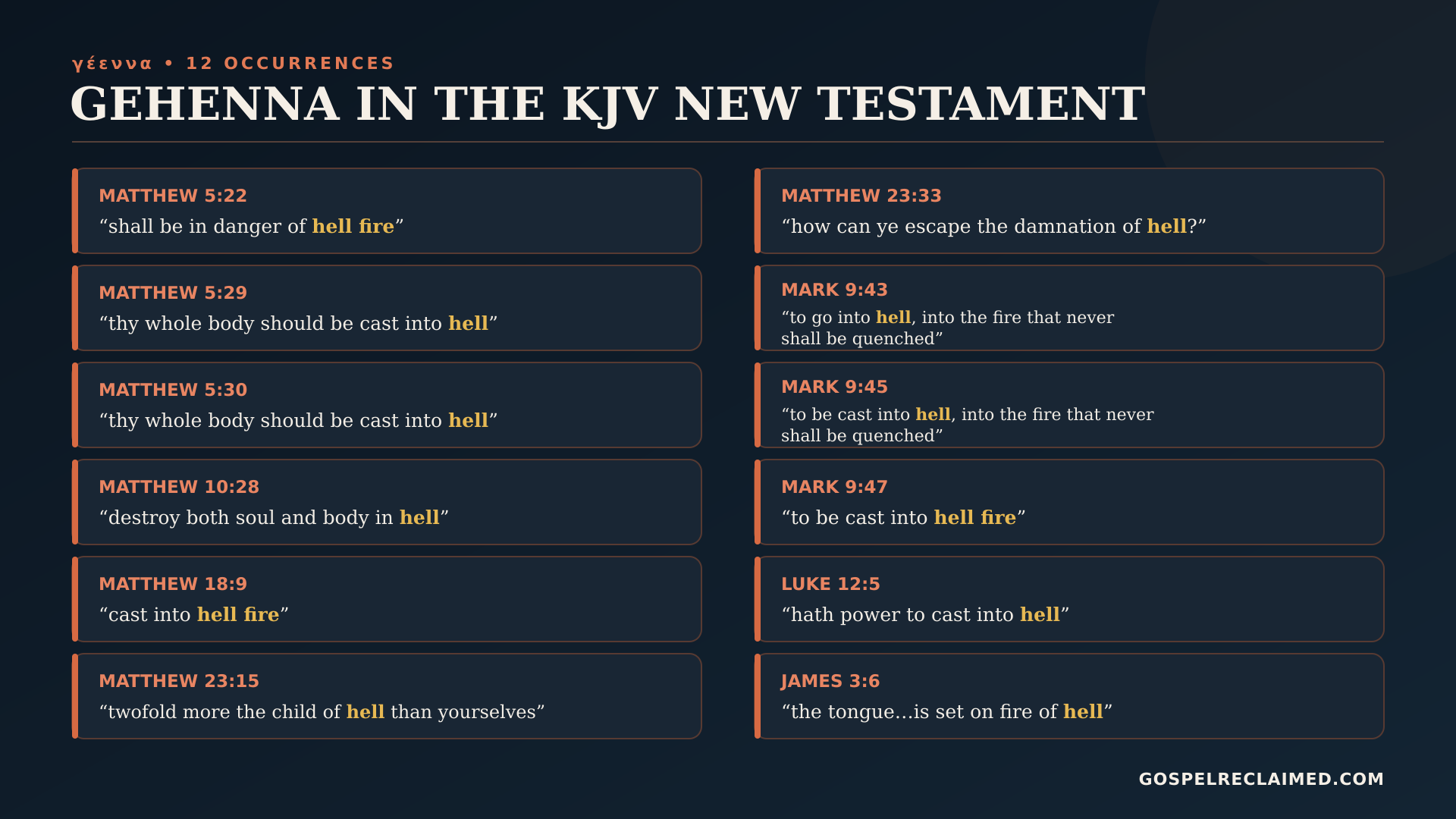
- Matthew 5:22 — “But I say unto you, That whosoever is angry with his brother without a cause shall be in danger of the judgment: and whosoever shall say to his brother, Raca, shall be in danger of the council: but whosoever shall say, Thou fool, shall be in danger of hell [Gehenna] fire.
- Matthew 5:29 — “And if thy right eye offend thee, pluck it out, and cast it from thee: for it is profitable for thee that one of thy members should perish, and not that thy whole body should be cast into hell [Gehenna].
- Matthew 5:30 — “And if thy right hand offend thee, cut it off, and cast it from thee: for it is profitable for thee that one of thy members should perish, and not that thy whole body should be cast into hell [Gehenna].
- Matthew 10:28 — “And fear not them which kill the body, but are not able to kill the soul: but rather fear him which is able to destroy both soul and body in hell [Gehenna].
- Matthew 18:9 — “And if thine eye offend thee, pluck it out, and cast it from thee: it is better for thee to enter into life with one eye, rather than having two eyes to be cast into hell [Gehenna] fire.”
- Matthew 23:15 — “Woe unto you, scribes and Pharisees, hypocrites! for ye compass sea and land to make one proselyte, and when he is made, ye make him twofold more the child of hell [Gehenna] than yourselves.”
- Matthew 23:33 — “Ye serpents, ye generation of vipers, how can ye escape the damnation of hell [Gehenna]?”
- Mark 9:43 — “And if thy hand offend thee, cut it off: it is better for thee to enter into life maimed, than having two hands to go into hell [Gehenna], into the fire that never shall be quenched:”
- Mark 9:45 — “And if thy foot offend thee, cut it off: it is better for thee to enter halt into life, than having two feet to be cast into hell [Gehenna], into the fire that never shall be quenched:”
- Mark 9:47 — “And if thine eye offend thee, pluck it out: it is better for thee to enter into the kingdom of God with one eye, than having two eyes to be cast into hell [Gehenna] fire:”
- Luke 12:5 — “But I will forewarn you whom ye shall fear: Fear him, which after he hath killed hath power to cast into hell [Gehenna]; yea, I say unto you, Fear him.”
- James 3:6 — “And the tongue is a fire, a world of iniquity: so is the tongue among our members, that it defileth the whole body, and setteth on fire the course of nature; and it is set on fire of hell [Gehenna].”
🚩 Apart from James 3:6, every occurrence of Gehenna is confined to the Synoptic Gospels—Matthew, Mark, and Luke. It never appears in the Gospel of John, Acts, Paul’s letters, Peter’s letters, John’s letters, Jude, Hebrews, or even Revelation.
Its only appearance outside the Gospels is in James, where the word is used symbolically:
“And the tongue is a fire, a world of iniquity…and it is set on fire of hell [Gehenna].”
— James 3:6
A human tongue is obviously not literally burning in an afterlife location. James uses Gehenna as an image of corruption, destruction, and the devastating consequences produced by evil.
If Gehenna were the name of an eternal place of conscious torment awaiting humanity, we would reasonably expect Paul to have warned tirelessly about it in every city he visited and in every letter he wrote. Yet he never once uses the word Gehenna. Neither do Peter or John. Even Revelation—with all its intense imagery of fire, death, and judgment—never mentions it.
For something later presented as the eternal destiny of billions, its near-total absence from the New Testament is impossible to ignore. 🤔
What About the Unquenchable Fire and the Worm That Does Not Die?
When Jesus spoke of Gehenna as a place where the fire “never shall be quenched,” He was again using the language of Israel’s prophets.
Jeremiah had warned Jerusalem:
“Then will I kindle a fire in the gates thereof, and it shall devour the palaces of Jerusalem, and it shall not be quenched.” — Jeremiah 17:27 KJV
That fire is not still burning today. “Unquenchable” did not mean that the fire would remain alive for eternity. It meant that no one would be able to extinguish it until it had completely consumed everything perishable.
Jesus’ words in Mark 9 also echo Isaiah 66:24:
“And they shall go forth, and look upon the carcases of the men that have transgressed against me: for their worm shall not die, neither shall their fire be quenched.”
Isaiah described corpses, not immortal souls being consciously tortured or eaten alive. Jesus used this prophetic imagery to warn of destruction, disgrace, and exclusion from the life of the coming kingdom.
That judgment arrived in AD 70 when Roman armies besieged Jerusalem and burned its Temple, ending their corrupt and religious system. Gehenna’s fire belonged to history, not eternity. It marked the end of an age, not the endless destiny of human souls.
Tartaroō — The Confinement of Rebellious Angels
The final Greek word translated “hell” is tartaroō (ταρταρόω), a verb meaning to cast or confine in Tartarus. It appears only once:
“For if God spared not the angels that sinned, but cast them down to hell [tartaroō], and delivered them into chains of darkness, to be reserved unto judgment.” — 2 Peter 2:4 KJV
Peter is referring to rebellious agents, messengers (Greek angeloi) being confined in darkness while awaiting judgment. His imagery draws from Jewish apocalyptic tradition and the ancient Greek concept of Tartarus as a deep prison for rebellious divine beings (paganism).
Jude uses similar imagery:
“And the angels which kept not their first estate, but left their own habitation, he hath reserved in everlasting chains under darkness unto the judgment of the great day.” — Jude 6 KJV
Although Jude describes the chains as “everlasting,” he does not present this confinement as their final destination. They are being held “until the judgment of the great day.” (ESV)
Peter also says that after His death, Christ went and proclaimed to “the spirits in prison”—those who had disobeyed in the days of Noah (1 Peter 3:18–20). If these are the same imprisoned beings, then whatever tartaroō represents, it was not beyond the reach of Christ.
Regardless of how we understand these mysterious beings, neither Peter nor Jude presents Tartarus as the eternal destination of humanity.
Four Different Words — One Hell of a Mistranslation
By rendering Sheol, Hades, Gehenna, and tartaroō with the single English word “hell,” translators created the illusion that Scripture repeatedly describes one universal place of eternal torment.
It does not.
Scripture certainly speaks of death, judgment, destruction, correction, and divine fire. But it never combines these four distinct ideas into the doctrine Christianity later called “hell.”
That doctrine emerged only after biblical words were stripped of their original language and context and stitched together beneath one terrifying English label.
For a closer look at how this doctrine distorted the character of God and the message of the Gospel, watch bellow or read my full article, “Hell — The Most Evil Doctrine of All Time.”
Restore the original words, and the traditional hell begins to disappear.
🏆 What remains is not a God who tortures without end, but Christ—the One who entered death, conquered the grave, and emptied both of their power:
“I am he that liveth, and was dead; and, behold, I am alive for evermore, Amen; and have the keys of hell [Hades] and of death.” — Revelation 1:18 KJV
“But is now made manifest by the appearing of our Saviour Jesus Christ, who hath abolished death, and hath brought life and immortality to light through the gospel.” — 2 Timothy 1:10 KJV
“Death is swallowed up in victory. O death, where is thy sting? O grave [Hades], where is thy victory?… But thanks be to God, which giveth us the victory through our Lord Jesus Christ.” — 1 Corinthians 15:54–55, 57 KJV
Because Christ has destroyed the power of death and the grave, we must stop treating every biblical image of judgment as another name for “hell.”
The lake of fire, everlasting fire, unquenchable fire, the abyss, outer darkness, and the bottomless pit must each be examined within their own language, literary setting, and historical context. They should not be silently classified as hell, nor conflated with Hades, Gehenna, or Tartarus.
I explore these related images more deeply in “The Lake of Fire — Where Lies Go to Die.”
One English word created the illusion of one doctrine. But the original words tell three very different stories—and none of them is the story of eternal conscious torment.
Their story does not end with humanity imprisoned in death. It ends with death itself swallowed up in victory.
God’s story does not end in hell. It ends in Christ.
FAQs
What words are translated as “hell”?
The KJV renders four different biblical terms as “hell”: the Hebrew Sheol and the Greek Hades, Gehenna, and tartaroō.
How many times does “hell” appear in the New Testament?
It appears 23 times in the KJV: ten times for Hades, twelve for Gehenna, and once for tartaroō. Hades is also translated “grave” once.
Do Sheol, Hades, Gehenna, and Tartarus mean the same thing?
No. They come from different historical and linguistic contexts and do not describe one universal place of eternal conscious torment.