⚠️ Every post begins with a question and grows from my ongoing search to know God and understand His purpose for humanity. What you read here reflects my current view—born from study and wonder—and I often revisit and update my writings as I continue to learn and see more clearly.
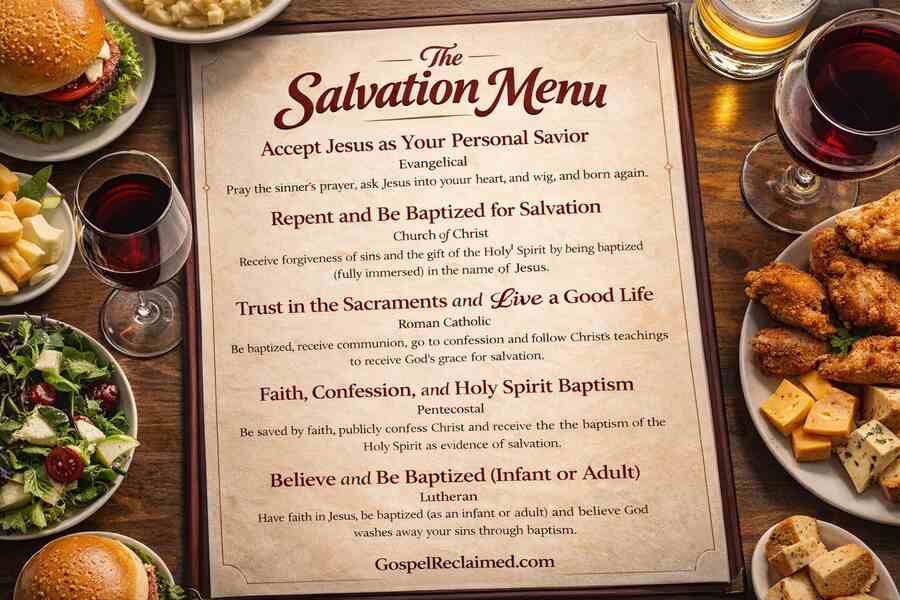
Alright, buckle up, because we’re diving into the wild and wacky world of Christian salvation, where everyone has an opinion. Welcome to the theological salad bar: a buffet of doctrines, each served with a side of certainty. You’ll find doctrines from theologians, pastors, and even TikTok evangelists, all sure they have the right recipe for salvation.
For centuries, well-meaning (or control-driven) folks have peddled salvation as a cosmic checklist: say the magic prayer, get dunked in water, or join the right denomination. But is that the truth? When we take verses in isolation, they morph into checklists, denominational slogans, or even theological weapons.
But the Gospel was never meant to be a transaction; it’s an announcement: God in Christ has already rescued humanity from sin and death. You don’t qualify for it; you wake up to it.
The “Salvation Menu” Problem
Ask ten Christians how to be saved, and you’ll get ten different recipes, each with its own secret sauce. Faith alone? Baptism? Confession? Endurance? A heartfelt sinner’s prayer?
Depending on the church sign out front, the path to salvation is redefined, turning Good News into a maze of conditions and contradictions. In what follows, you’ll see just how inconsistent and limited these interpretations can be when taken as standalone doctrines. Every verse is true, but none alone holds the full picture.
Let’s take a closer look at the salvation menu (deep breath — the list is long):
John 3:16 — “For God so loved the world, that he gave his only begotten Son, that whosoever believeth in him should not perish, but have everlasting life.”
Let’s start with the obvious.
If I believe in Jesus, am I saved—period?
Faith alone–right?
Ephesians 2:8–9 — “For by grace are ye saved through faith; and that not of yourselves: it is the gift of God:
Not of works, lest any man should boast.”
If I believe in Jesus even for a moment, am I saved once and for all—regardless of what I do with my life?
Grace alone—correct?
Ephesians 1:4–5 — “According as he hath chosen us in him before the foundation of the world, that we should be holy and without blame before him in love: Having predestinated us unto the adoption of children by Jesus Christ to himself, according to the good pleasure of his will.”
If God already decided who will be saved, what role do belief, repentance, or obedience play?
And what about a non-chosen person who believes—are they simply wasting their time?
Acts 16:31 — “And they said, Believe on the Lord Jesus Christ, and thou shalt be saved, and thy house.”
If I believe, is my entire household automatically saved?
It seems to say so.
Mark 2:5 — “When Jesus saw their faith, he said unto the sick of the palsy, Son, thy sins be forgiven thee.”
Can someone else’s faith forgive my sins?
James 2:19 — “Thou believest that there is one God; thou doest well: the devils also believe, and tremble.”
So belief alone is not enough?
James 2:14 — “What doth it profit, my brethren, though a man say he hath faith, and have not works? Can faith save him?”
If works are required to validate faith, what is the passing grade?
James never specifies.
Romans 10:14 “How then shall they call on him in whom they have not believed? and how shall they believe in him of whom they have not heard? and how shall they hear without a preacher?”
What about those who will never hear the gospel?
Are they simply out of luck?
Romans 10:9 — “That if thou shalt confess with thy mouth the Lord Jesus, and shalt believe in thine heart that God hath raised him from the dead, thou shalt be saved.”
What about those who are non-verbal or unable to confess with their mouth?
Does salvation require exceptions?
Acts 3:19 — “Repent ye therefore, and be converted, that your sins may be blotted out.”
Is repentance—understood as regret or moral reform—a requirement for forgiveness?
What about sins I don’t yet recognize?
Is ignorance somehow excused?
Acts 2:38 — “Then Peter said unto them, Repent, and be baptized every one of you in the name of Jesus Christ for the remission of sins…”
Mark 16:16 — “He that believeth and is baptized shall be saved; but he that believeth not shall be damned.”
Is it repentance plus baptism?
Faith plus baptism?
Sprinkling or immersion?
As a child or as an adult?
1 John 1:9 — “If we confess our sins, he is faithful and just to forgive us our sins, and to cleanse us from all unrighteousness.”
To whom must sins be confessed—God, a priest, or one another?
What if I forget some of them?
Is forgetfulness an exception?
Matthew 6:14–15 — “For if ye forgive men their trespasses, your heavenly Father will also forgive you: But if ye forgive not men their trespasses, neither will your Father forgive your trespasses.”
If forgiveness functions as a prerequisite for divine forgiveness, how does this framework account for those outside the gospel’s reach who nonetheless practice forgiveness?
1 Corinthians 7:14 — “For the unbelieving husband is sanctified by the wife, and the unbelieving wife is sanctified by the husband…”
Is an unbelieving husband rendered holy—and therefore saved—by his wife’s faith alone?
And what about believing husbands? Do they likewise sanctify their wives by their faith?
1 Timothy 2:15 — “Notwithstanding she shall be saved in childbearing, if they continue in faith and charity and holiness with sobriety.”
What of barren women, the unmarried, or those who never desired children?
Are they somehow disqualified from salvation?
Matthew 10:22 — “But he that endureth to the end shall be saved.”
Revelation 2:10 — “Be thou faithful unto death, and I will give thee a crown of life.”
What does it mean to endure to the end?
And what, exactly, must be endured?
Romans 11:26 — “And so all Israel shall be saved: as it is written, There shall come out of Sion the Deliverer, and shall turn away ungodliness from Jacob.”
If I am Jewish, am I saved regardless of belief, works, baptism, confession, repentance, childbearing, or endurance?
Now… can you see the mess?
When taken in isolation, these verses morph into checklists, denominational slogans, and sometimes… theological weapons.
This is what happens when the Good News gets reduced to a religious contract.
The Gospel isn’t a two-way transaction; it’s a cosmic announcement: God in Christ has already rescued humanity from sin and death.
You don’t qualify for it.
You wake up to it.

Not All “Sōzō” Is Created Equal
Before “salvation” became a formula to escape “hell,” the word sōzō held a much deeper meaning. In the New Testament, sōzō means to heal, deliver, rescue, and make whole. It’s not about where you go when you die—it’s about being restored while you’re still alive.
We see it all over the Gospels and Acts:
Mark 5:34 – “Daughter, your faith has made you well (sōzō)…”
→ Physical healing – restoration from years of suffering.Luke 8:36 – “…how the demon-possessed man had been healed (sōzō).”
→ Spiritual deliverance – liberation from torment and chaos.Acts 27:31 – “Unless these men stay in the ship, you cannot be saved (sōzō).”
→ Physical rescue – salvation from danger and death.
And then there’s the kind of sōzō that happens when your heart hears the truth, your mind shifts (that’s metanoia), and you suddenly remember who you are—not a sinner begging for mercy, but someone made by God, included in Christ, and restored to wholeness.
John 17:3 – Eternal life is knowing the Father and the Son.
→ Salvation is relationship, not destination.
Romans 12:2 – Be transformed by the renewing of your mind.
→ Transformation follows revelation.
Ephesians 1:17–18 – That you may know the hope of His calling.
→ Metanoia awakens identity.
This is the Good News:
❤️You’ve always belonged.
❤️ You’ve always been loved.
❤️ You’ve always been part of God’s plan to restore everything in Christ.
Salvation isn’t a transaction or checklist. It’s the rescue from lies of separation and shame so we can live in the truth of our union with Christ, now.
That’s the kind of salvation by faith that actually matters.
Not “one day in heaven,” but wholeness, freedom, and life—today.
And once you see that?
The whole menu of contract-based religion just doesn’t satisfy anymore.
The Transcendent Choice — God’s Eternal Plan to Include Us All in Christ
Here’s the mystery: before time even ticked, God made a decision—not just to rescue us from something, but to include us in Someone. Salvation wasn’t an afterthought; it was woven into the fabric of eternity, anchored in Christ from the start. This wasn’t about offering us a lifeline someday; it was about placing us in the very heart of God’s purpose from the start.
And this purpose was never limited to a select few. God has predestined His whole creation to be united in Christ—not just a small group, as Calvinism teaches, but all things in heaven and on earth. His plan was always inclusive, cosmic, and complete: that in the fullness of time, everything would be restored through Jesus (Acts 3:21).
Ephesians 1:3–6 – “Blessed be the God and Father of our Lord Jesus Christ, who has blessed us in Christ with every spiritual blessing in the heavenly places, even as He chose us in Him before the foundation of the world, that we should be holy and blameless before Him. In love He predestined us for adoption to Himself as sons through Jesus Christ, according to the purpose of His will, to the praise of His glorious grace…”
Ephesians 1:9–11 – “…making known to us the mystery of His will, according to His purpose, which He set forth in Christ as a plan for the fullness of time, to unite all things in Him… In Him we have obtained an inheritance, having been predestined according to the purpose of Him who works all things according to the counsel of His will.”
2 Timothy 1:9–10 – “He saved us and called us to a holy calling, not because of our works but because of His own purpose and grace, which He gave us in Christ Jesus before the ages began, and which now has been manifested through the appearing of our Savior Christ Jesus, who abolished death and brought life and immortality to light through the gospel…”
Salvation is not a timeline.
It’s not a future reward.
It’s not a deal waiting on our response.
It’s an eternal reality—already accomplished, already revealed—waiting for us TO WAKE UP and live from it… through faith!
BONUS:
The Finished Work: Rescued, Included, Restored
God in Christ has rescued humanity from sin and death
Romans 5:18 –“But God proves His love for us in this: While we were still sinners, Christ died for us.“
Romans 5:18 –“Therefore, as one trespass led to condemnation for all men, so one act of righteousness leads to justification and life for all men.”
He has included all in Himself
Colossians 3:3 –“For you have died, and your life is hidden with Christ in God.”
Ephesians 1:10 –“…as a plan for the fullness of time, to unite all things in Him, things in heaven and things on earth.”
He has restored the image of God that was distorted by the Fall
Titus 2:14 –“He gave Himself for us to redeem us from all lawlessness and to purify for Himself a people for His own possession, zealous for good deeds.”
Ephesians 2:10 –“For we are God’s workmanship, created in Christ Jesus to do good works, which God prepared in advance as our way of life.”
Live Like You’re Loved
Here’s the powerful part: you’re not just saved from something; you’re saved for something – a life of purpose, joy, and unshakable trust. So, ditch the spiritual insecurity. Stop second-guessing your status with God. You’re not a cosmic intern hoping for a permanent gig, you’re a beloved child of the King. Walk in that truth. Love boldly. Forgive freely. And when the world throws shade, remember: you’re already seated in heavenly places. Act like it.
1 Timothy 6:18-19 –“Instruct them to do good, to be rich in good works, to be generous and ready to share, storing up for themselves the treasure of a good foundation for the future, so that they may take hold of that which is truly life.“
FAQs
How are we saved?
Salvation isn’t a transaction or checklist. It’s the rescue from lies of separation and shame so we can live in the truth of our union with Christ, now.
What does sōzō mean?
In the New Testament, sōzō means to heal, deliver, rescue, and make whole. It’s not about where you go when you die—it’s about being restored while you’re still alive.
What is the true Gospel?
The Gospel isn’t a two-way transaction; it’s a cosmic announcement: God in Christ has already rescued humanity from sin and death.
You don’t qualify for it.
You wake up to it.