⚠️ Every post begins with a question and grows from my ongoing search to know God and understand His purpose for humanity. What you read here reflects my current view—born from study and wonder—and I often revisit and update my writings as I continue to learn and see more clearly.
Few teachings have shaped the modern Christian imagination as vividly as the rapture—the expectation that believers will suddenly be taken from the earth before a period of worldwide tribulation.
But when did this doctrine emerge, and is that what the biblical writers originally described?
This study will trace the language of Paul, the historical setting of Israel’s prophecies, and Scripture’s vision of the end.
What does rapture [harpazō] actually mean?
Who was facing the promised tribulation?
And where does the biblical story say creation is ultimately heading?
We will follow the words, audiences, and contexts of the passages themselves—and allow Scripture to answer.
This version directly rejects the system while preserving an important linguistic distinction: Paul’s words were stripped of their context and expanded into a doctrine they never express.
How “Caught Up” Became the Rapture Doctrine
For most of Christian history, believers confessed the resurrection of the dead, the appearing of Christ, and the renewal of creation. What did not appear until the modern era was the fully developed prophetic system known as the pretribulation rapture: the alleged secret removal of the Church before seven years of worldwide tribulation, followed by a separate, public coming of Christ.
* Other traditions place the gathering during or after the tribulation, but only the first scenario is properly called pretribulationism.
Although earlier Christians discussed resurrection, tribulation, and believers being “caught up,” the recognizable pretribulation system took shape during the 19th century.
John Nelson Darby became its principal architect during the British and Irish prophetic movements of the 1820s and 1830s. His theology sharply separated Israel from the Church and divided Christ’s coming into two events: Christ would first remove the Church and return with believers to heaven; then, after God resumed His prophetic program with national Israel, Christ would return publicly.
The system spread throughout North America and was later placed beside the biblical text in the notes of the Scofield Reference Bible, first published in 1909. From there, it entered Bible conferences worldwide, seminaries, evangelical preaching, prophecy books, films, and eventually the enormously successful Left Behind series.
Historians therefore describe the modern pretribulation system as a 19th-century development. The biblical passages used to construct it are ancient; what was new was the framework that combined them into this particular sequence.
The passage that supplied the doctrine with its name and central image was 1 Thessalonians 4:16–17.
📖 1 Thessalonians 4:16–17 — Resurrection and Reunion
“For the Lord himself shall descend from heaven with a shout, with the voice of the archangel, and with the trump of God: and the dead in Christ shall rise first: Then we which are alive and remain shall be caught up together with them in the clouds, to meet the Lord in the air: and so shall we ever be with the Lord.” — 1 Thessalonians 4:16–17 KJV
The expression “caught up” translates harpagēsometha, a form of the Greek verb harpazō: to seize, take hold of, or snatch suddenly. The 4th-century Latin Vulgate rendered it rapiemur, from rapio, which eventually produced the English word rapture.
The problem begins when “caught up” is treated as shorthand for an entire prophetic sequence that Paul never describes: a secret disappearance from the earth, removal to heaven, seven years of worldwide tribulation, and another coming of Christ afterward.
⚠️ Paul’s description is anything but secret.
The Lord descends with a shout, the voice of the archangel, and the trumpet of God. The redeemed are gathered to meet the descending Lord, but Paul never says that Christ reverses direction and takes them to heaven.
Paul identifies his actual concern at the beginning of the passage:
“But I would not have you to be ignorant, brethren, concerning them which are asleep, that ye sorrow not, even as others which have no hope.” — 1 Thessalonians 4:13 KJV
Paul was comforting the church in Thessalonica as they grieved members of their community who had died. For a deeper understanding of the historical circumstances surrounding this young, persecuted church—and why these deaths created such urgent concern—see the accompanying contextual footnote.1
His assurance was that the dead would not be excluded from Christ’s coming [parousia]. The living would not “prevent”—or precede—them. The dead would rise, the living would be gathered with them, and both groups would meet the Lord.
💡 The subject is resurrection and reunion, not evacuation before tribulation.
Together, “caught up” and “meet” describe Christ’s descent, the resurrection of the dead, and the gathering of the living to meet Him. They do not establish a departure to heaven, a partial and temporary disappearance, or the prophetic itinerary later assigned to them.

Harpazō is an ordinary Greek verb meaning to seize, snatch, take, or carry away forcefully. It is not the name of a prophetic event or theological doctrine.
- Matthew 11:12 — the forceful “take” the kingdom
- Matthew 13:19 — the evil one “snatches away” the seed
- John 6:15 — the crowd attempts to “take” Jesus by force
- John 10:12 — the wolf “snatches” the sheep
- John 10:28–29 — no one can “snatch” them from Christ’s hand
- Acts 8:39 — Philip is suddenly “carried away”
- Acts 23:10 — soldiers “take” Paul by force from the crowd
- Jude 23 — people are rescued by “snatching” them from the fire
The verb itself says nothing about a secret disappearance, a destination in heaven, a tribulation, or a seven-year period.
The Rapture Puzzle
Because 1 Thessalonians 4 does not contain the complete, popular rapture doctrine, interpreters must gather passages from different books, addressed to different audiences and written for different purposes, to supply its missing elements.
Verses about bodily transformation, heavenly citizenship, deliverance from wrath, preservation during trial, Christ’s appearing, and dwelling with Him were assembled as scattered pieces of a single prophetic puzzle.
🚩 Yet a collection of verses does not become one unified doctrine merely because its pieces can be arranged to resemble it. When each passage is returned to its own argument and historical context, the pieces do not converge to form the expected image.
The first question, therefore, should not be how these verses can be fitted into the rapture system, but what each passage actually communicates within its own argument.
Do the texts themselves connect these promises to a secret removal of the Church before seven years of worldwide tribulation?
🚩 Was Paul really scattering clues throughout his letters, leaving readers to assemble them into such an important doctrine—one he never explains in any single passage?
Before these texts can legitimately be joined together, each must first be allowed to speak within its own context.
📖 1 Corinthians 15:51–52 — The Last Trumpet and the Defeat of Death
“Behold, I shew you a mystery; We shall not all sleep, but we shall all be changed,
In a moment, in the twinkling of an eye, at the last trump: for the trumpet shall sound, and the dead shall be raised incorruptible, and we shall be changed.
For this corruptible must put on incorruption, and this mortal must put on immortality. So when this corruptible shall have put on incorruption, and this mortal shall have put on immortality, then shall be brought to pass the saying that is written, Death is swallowed up in victory.
O death, where is thy sting? O grave, where is thy victory?” — 1 Corinthians 15:51–55 KJV
First Corinthians 15 is Paul’s most extensive discussion of resurrection. After proclaiming Christ’s death, burial, and resurrection, Paul confronts those in Corinth who claimed “that there is no resurrection of the dead” (verse 12).
- His answer is the pattern established in Christ:
“But now is Christ risen from the dead, and become the firstfruits of them that slept.” — 1 Corinthians 15:20 KJV
- Christ is the firstfruits; His resurrection anticipates the harvest that follows:
“For as in Adam all die, even so in Christ shall all be made alive.” — 1 Corinthians 15:22 KJV
- The chapter then moves toward the destruction of the final enemy:
“The last enemy that shall be destroyed is death.” — 1 Corinthians 15:26 KJV
This is the context in which Paul introduces the “mystery.”
(image The Mystery)
It is not the secret disappearance of a portion of humanity, but the transformation of both the dead and the living:
“We shall not all sleep, but we shall all be changed.”
“Sleep” is Paul’s metaphor for death. Some will have died; others will remain alive. The dead will be raised incorruptible, the living will be changed, and mortality will put on immortality.
Paul then describes the suddenness and public signal accompanying this shared transformation:
“In a moment, in the twinkling of an eye, at the last trump…”
🔎 Throughout Scripture, trumpets announce decisive divine action:
- At Sinai, the trumpet accompanies God’s descent and the assembly of Israel (Exodus 19:16–19).
- Isaiah’s “great trumpet” announces the gathering of God’s scattered people (Isaiah 27:13).
- The prophets associate trumpets with the Day of the Lord and divine appearance (Joel 2:1; Zechariah 9:14).
- Jesus associates the trumpet with the gathering of the elect (Matthew 24:31).
- Paul uses the trumpet as a clear public signal calling people to action (1 Corinthians 14:8).
The trumpet therefore signifies divine appearance, public announcement, assembly, and resurrection—not a silent and concealed event.
Paul does not enumerate a series of previous trumpets or provide a prophetic chart explaining why this one is “last.” Within his argument, it announces the decisive transformation in which mortality gives way to immortality and death is swallowed up in victory.
💡 It is the trumpet of resurrection.
The “last trumpet” should not automatically be equated with Revelation’s seventh trumpet, which belongs to a different book and setting. Neither can it be redefined as “the final trumpet before a seven-year interruption,” followed by additional trumpets, judgments, resurrections, and another coming of Christ.
Nothing in 1 Corinthians establishes such a sequence. Nothing is said about the redeemed leaving the earth, spending seven years in heaven, escaping a worldwide tribulation, or returning with Christ afterward. Paul’s stated outcome is incorruption, immortality, and the victory of life over death.
📖 1 Thessalonians 5:9 — Is “Wrath” the Great Tribulation?
“For God hath not appointed us to wrath [orgē], but to obtain salvation by our Lord Jesus Christ,
Who died for us, that, whether we wake or sleep, we should live together with him. Wherefore comfort yourselves together, and edify one another, even as also ye do.” — 1 Thessalonians 5:9–11 KJV
This passage is frequently used to supply a chronology absent from 1 Thessalonians 4.
The reasoning of rapture proponents generally proceeds as follows:
- Believers are “caught up” in 1 Thessalonians 4.
- Believers are not appointed to “wrath” in 1 Thessalonians 5.
- The worldwide tribulation is assumed to be God’s wrath.
- Therefore, believers must be caught up before the tribulation begins.
The crucial second and third steps, however, are never stated in the text. 🚩 Paul does not define wrath as a seven-year worldwide tribulation, nor does he say that deliverance from it requires physical removal from the earth.
The contrast Paul constructs is:
- God did not appoint [tithēmi] us toward wrath [orgē].
- God appointed us toward the obtaining [peripoiēsis] of salvation [sōtēria: deliverance, wholeness, healing].
The context begins in 1 Thessalonians 5:1 with “the times and the seasons” and the Day of the Lord. That day comes as a thief upon those declaring “peace and safety,” but Paul immediately tells the Thessalonians:
“But ye, brethren, are not in darkness, that that day should overtake you as a thief.” — 1 Thessalonians 5:4 KJV
The Day Comes “as a Thief”—But Is It Secret?
Paul does not say the day cannot overtake them because they will no longer be on the earth, but because they are not in darkness [ignorance]. They are “children of light” and “children of the day” who are told to remain awake, sober, faithful, loving, and hopeful.
His emphasis is spiritual living:
“But since we belong to the day, let us be sober, having put on the breastplate of faith and love, and for a helmet the hope of salvation.” — 1 Thessalonians 5:8 ESV
Verse 10 also returns to the concern of the preceding chapter: “Whether we wake or sleep, we should live together with him.” The conclusion is the same pastoral instruction found in 1 Thessalonians 4:18: comfort and encourage one another.
The passage promises salvation from orgē. It never identifies that orgē as a seven-year tribulation and never identifies removal from the earth as the method of salvation.
So, Is Wrath Something to Fear?
The English word “wrath” translates the Greek orgē [ὀργή], a word conveying anger, indignation, or an intense and settled opposition. Its imagery is associated with an impulse that rises or swells into action.
💡 In reference to God, however, orgē should not be imagined as an uncontrolled outburst of rage. Divine orgē is God’s intense and passionate opposition to everything that corrupts, enslaves, and destroys His creation.
“For the wrath [orgē] of God is revealed from heaven against all ungodliness and unrighteousness of men, who suppress the truth in unrighteousness.” — Romans 1:18
Notice what God’s orgē is revealed against: ungodliness and unrighteousness—everything that suppresses truth and prevents humanity from living in the freedom of its true identity. God’s opposition to such things is not separate from His love; it is the necessary expression of a love that refuses to make peace with whatever harms His creation.
John’s Gospel likewise states:
“Whoever believes in the Son has eternal life [zōē aiōnios]; whoever does not obey the Son shall not see life, but the wrath [orgē] of God remains on him.” — John 3:36 ESV
Jesus later defines zōē aiōnios as knowing the Father and the Son (John 17:3). Those who do not yet has, experience that life remain beneath God’s zealous opposition to the unbelief, falsehood, and corruption that keep them from recognizing and enjoying this relationship.
God’s orgē, therefore, should not be confused with divine hatred or an intention to abandon. It is the fierce movement of divine love against everything that prevents His children from experiencing His life.
For a deeper examination of how God’s wrath and justice express rather than contradict His love, read God Is Love, But….
📖 1 Thessalonians 1:10 — Rescue From Imminent Wrath
“And to wait for his Son from heaven, whom he raised from the dead, even Jesus, which delivered us from the wrath to come.” — 1 Thessalonians 1:10 KJV
The Greek word rhyomai means to rescue or deliver from danger; it does not imply physical removal to heaven.
Likewise, “the wrath to come” is tēs orgēs tēs erchomenēs—“the coming orgē.”
Paul distinguishes this orgē from affliction [thlipsis]. The Thessalonians had received the gospel “in much affliction” (1:6), and Paul reminded them that they were “appointed thereunto” (3:3). They could experience persecution without being the objects of the orgē from which Christ rescued them.
Within the same letter, Paul writes:
“For the wrath is come upon them to the uttermost.” — 1 Thessalonians 2:16 KJV
Paul could therefore speak of orgē as coming in 1:10 and as already overtaking people in 2:16. Whatever precise historical event he had in view, his usage does not support redefining orgē as a distant seven-year tribulation.
The hope of 1 Thessalonians 1:10 is Jesus Himself—the risen Son coming as Rescuer—not a secret removal to heaven.
📖 Revelation 3:10 — “Keep from” Not “Remove from the Earth”
“Because you have kept my word about patient endurance, I will keep [tēreō] you from the hour of trial [peirasmos] that is coming on the whole world, to try those who dwell on the earth.” — Revelation 3:10 ESV
This promise was addressed to the historical assembly in Philadelphia, in Asia Minor. Christ commends them for keeping His word and not denying His name despite having “a little strength” (Revelation 3:8).
The Greek verb tēreō means to keep, guard, preserve, or protect—not to seize, catch up, or transport.
The strongest biblical comparison is Jesus’ prayer for His disciples:
“I do not ask that you take them out of the world, but that you keep them from the evil one..”
— John 17:15 ESV
John uses the same construction, tēreō ek, while explicitly distinguishing it from being taken out of the world. Jesus prays for preservation, not physical removal.
The noun translated “trial” is peirasmos, meaning a test, trial, temptation, or putting to the proof. It is not thlipsis, the word normally rendered “tribulation” or “affliction.”
🔥 Trials in Scripture are repeatedly portrayed as serving the purpose of testing and refining faith, producing endurance, and bringing men toward maturity (Romans 5:3–5; James 1:2–4; 1 Peter 1:6–7).
The surrounding instruction emphasizes perseverance, not escape:
“I am coming soon. Hold fast what you have, so that no one may seize your crown.” — Revelation 3:11 ESV
Revelation does not portray tribulation as something from which believers must be physically absent. John calls himself their “brother and partner in the tribulation.” (Revelation 1:9)
Smyrna is told, “For ten days you will have tribulation,” and instructed, “Be faithful unto death” (Revelation 2:10 ESV). Later, John sees “the ones coming out of the great tribulation” before the throne (Revelation 7:14 ESV).
Revelation 3:10 promises that Christ will guard Philadelphia in relation to an approaching trial. Turning this into the removal of the worldwide Church before a seven-year tribulation requires importing an audience, chronology, and method of deliverance that the verse never identifies.
📖 Titus 2:13 — Appearing Is a Manifestation, Not Secret Disappearance
“For the grace of God has appeared, bringing salvation for all people, training us to renounce ungodliness and worldly passions, and to live self-controlled, upright, and godly lives in the present age, waiting for our blessed hope, the appearing of the glory of our great God and Savior Jesus Christ, who gave himself for us to redeem us from all lawlessness and to purify for himself a people for his own possession who are zealous for good works.” — Titus 2:11–14 ESV
The movement of the passage begins with a universal declaration: “The grace of God has appeared, bringing salvation for all people.”
Grace does not appear merely to announce the possible escape of a select group. It appears bringing salvation for all humanity, and that same grace performs the work of training [paideuousa] mankind.
The verb paideuō means to educate, instruct, discipline, or form someone toward maturity. Salvation is therefore presented as God’s active, transforming work within human life: teaching us to renounce everything contrary to His nature and to live uprightly “in the present age.”
The passage then explains the purpose of Christ’s self-giving:
“Who gave himself for us to redeem us from all lawlessness and to purify for himself a people for his own possession.”
The phrase “purify for himself a people” echoes covenant language, describing a people formed to embody His character and become “zealous for good works.” The emphasis is vocation and transformation, not exclusion or evacuation.
Christ gives Himself to redeem us from lawlessness, purify, and form a people whose lives reveal the fruit of grace. These actions correspond directly to verse 12: the grace that brings salvation also trains people to live according to the life it has revealed.
💡 Titus 2 describes salvation as revelation, redemption, purification, and transformation—not the removal of a privileged group from the earth.
For the full context of “the blessed hope,” please, keep reading.
📖 Philippians 3:20–21 — Heavenly Citizenship and Bodily Transformation
“But our citizenship is in heaven, and from it we await a Savior, the Lord Jesus Christ, who will transform our lowly body to be like his glorious body, by the power that enables him even to subject all things to himself.” — Philippians 3:20–21 ESV
The Greek phrase translated “our lowly body” [to sōma tēs tapeinōseōs hēmōn] can also be rendered “the body of our humiliation.” It describes the human body in its present condition of weakness and mortality, not as something morally corrupt or worthless.
Christ will transform [metaschēmatizō] this body and make it conformed [symmorphos] to His glorious body. The body is not discarded for a disembodied existence in heaven; it is transformed according to the pattern of Christ’s resurrected humanity.
Paul does not say that believers are waiting to depart for heaven. Their citizenship is in heaven, and it is “from it” that they await the Savior (Philippians 3:20). Jesus likewise taught His disciples to pray for God’s kingdom to come and His heavenly will to be done “on earth as it is in heaven” (Matthew 6:10).
Philippi was a Roman colony whose citizens lived in Macedonia while possessing a political identity centered in Rome. Their Roman citizenship shaped how they lived in Philippi; it did not require them to relocate to Rome for that citizenship to be real.
Likewise, heavenly citizenship identifies the commonwealth to which believers belong and the allegiance that governs their lives—not their future geographical destination. (Cambridge, Philippians: Commentary; Greek entry for politeuma)
The surrounding passage contrasts two governing orientations:
“With minds set on earthly things.” — Philippians 3:19
“But our citizenship is in heaven.” — Philippians 3:20
Paul contrasts lives governed by earthly appetites with lives shaped by the heavenly commonwealth. His point is allegiance, identity, and transformation—not evacuation.
The climax confirms this. Christ possesses the power to “subject all things to himself.” The movement is not humanity abandoning creation, but Christ bringing all things under His life-giving authority.
- John 17:2 — Christ possesses authority “over all flesh” to give eternal life.
- Ephesians 1:10 — God’s purpose is to “gather together in one all things in Christ.”
- Colossians 1:20 — Through Christ, God reconciles “all things unto himself.”
- Acts 3:21 — Heaven receives Christ “until the times of restitution of all things.”
⚠️ Philippians 3 contains no harpazō, no meeting in the air, no tribulation, no seven-year period, no secret disappearance, and no departure to heaven. It speaks of the Savior being awaited from heaven, the transformation of the human body, and the subjection of all things to Christ.
📖 John 14:1–3 — Received to Christ, but Taken Where?
“Let not your heart be troubled: ye believe in God, believe also in me.
In my Father’s house are many mansions: if it were not so, I would have told you. I go to prepare a place for you. And if I go and prepare a place for you, I will come again, and receive you unto myself; that where I am, there ye may be also.” — John 14:1–3 KJV
John 14 is frequently used to supply the return to heaven missing from 1 Thessalonians 4. Christ allegedly descends from heaven, receives the Church, reverses direction, and carries the redeemed to heavenly mansions while the earth enters seven years of tribulation.
Jesus never describes that sequence.
The setting is the night before His crucifixion. Jesus has announced that He is leaving, and Peter has asked:
“Lord, whither goest thou?” — John 13:36 KJV
The disciples are troubled because the One they have followed is going somewhere they cannot yet follow. John 14:1–3 answers their fear with the assurance that His departure will not end their relationship. He will come again and receive them unto Himself.
The destination explicitly named in the promise is not heaven, but Christ:
“I will receive you unto myself.”
Thomas continues to think geographically:
“Lord, we know not whither thou goest; and how can we know the way?” — John 14:5 KJV
Jesus does not respond by describing a journey through the sky or giving directions to a heavenly location. He identifies the Way as a person:
“I am the way, the truth, and the life: no man cometh unto the Father, but by me.” — John 14:6 KJV
Jesus is not merely showing them the way to the Father; He Himself is the Way into the Father’s life and presence. His death, resurrection, and return to the Father would prepare what the disciples could not yet enter.
The phrase “that where I am, there ye may be also” had already appeared in connection with following Christ through death into life:
“If any man serve me, let him follow me; and where I am, there shall also my servant be.” — John 12:26 KJV
John 14 then explains where Christ is:
“I am in the Father, and the Father in me.” — John 14:10 KJV
And shortly afterward, Jesus explains how His disciples will be with Him there:
“At that day ye shall know that I am in my Father, and ye in me, and I in you.” — John 14:20 KJV
The promise is therefore about being brought into Christ’s own communion with the Father. Jesus is in the Father; humanity is received into Christ; and Christ comes to dwell within humanity.
This becomes even clearer in John 14:23:
“If a man love me, he will keep my words: and my Father will love him, and we will come unto him, and make our abode with him.” — John 14:23 KJV
The word translated “abode” is monē—the same Greek noun translated “mansions” in verse 2. These are its only two occurrences in the New Testament. The chapter itself therefore connects the dwelling places in the Father’s house with the Father and Son making their dwelling with humanity.
The direction is not simply humanity being taken away to live with God. The Father and Son come to humanity and make their abode within us.
Jesus promises:
“I will not leave you comfortless: I will come to you.” — John 14:18 KJV
Through the Holy Spirit, Christ’s presence would no longer be merely external and localized. He would abide in His people, and they would abide in Him. The temporary separation produced by His death would give way to permanent communion.
For a fuller examination of humanity’s inclusion and abiding union in Christ, read Who Is in Christ?.
John 14:1–3 is not about where the disciples will be transported, but how Jesus’ approaching departure will bring them into permanent communion with Himself and the Father. The Way is not an escape route to another location; the Way is Christ Himself. Rather than removing a select group from the earth, He comes to dwell in humanity and brings humanity into His own life with the Father.
📖 Matthew 24:40–41 and 25:1–13 — Taken, Left, and Ready for the Bridegroom
“Then shall two be in the field; the one shall be taken, and the other left.
Two women shall be grinding at the mill; the one shall be taken, and the other left.” — Matthew 24:40–41 KJV
These verses are frequently presented as a future rapture in which believers suddenly disappear while everyone else remains behind. Yet nothing in the passage mentions resurrection, bodily transformation, harpazō, ascent into the air, transportation to heaven, or a seven-year absence from the earth.
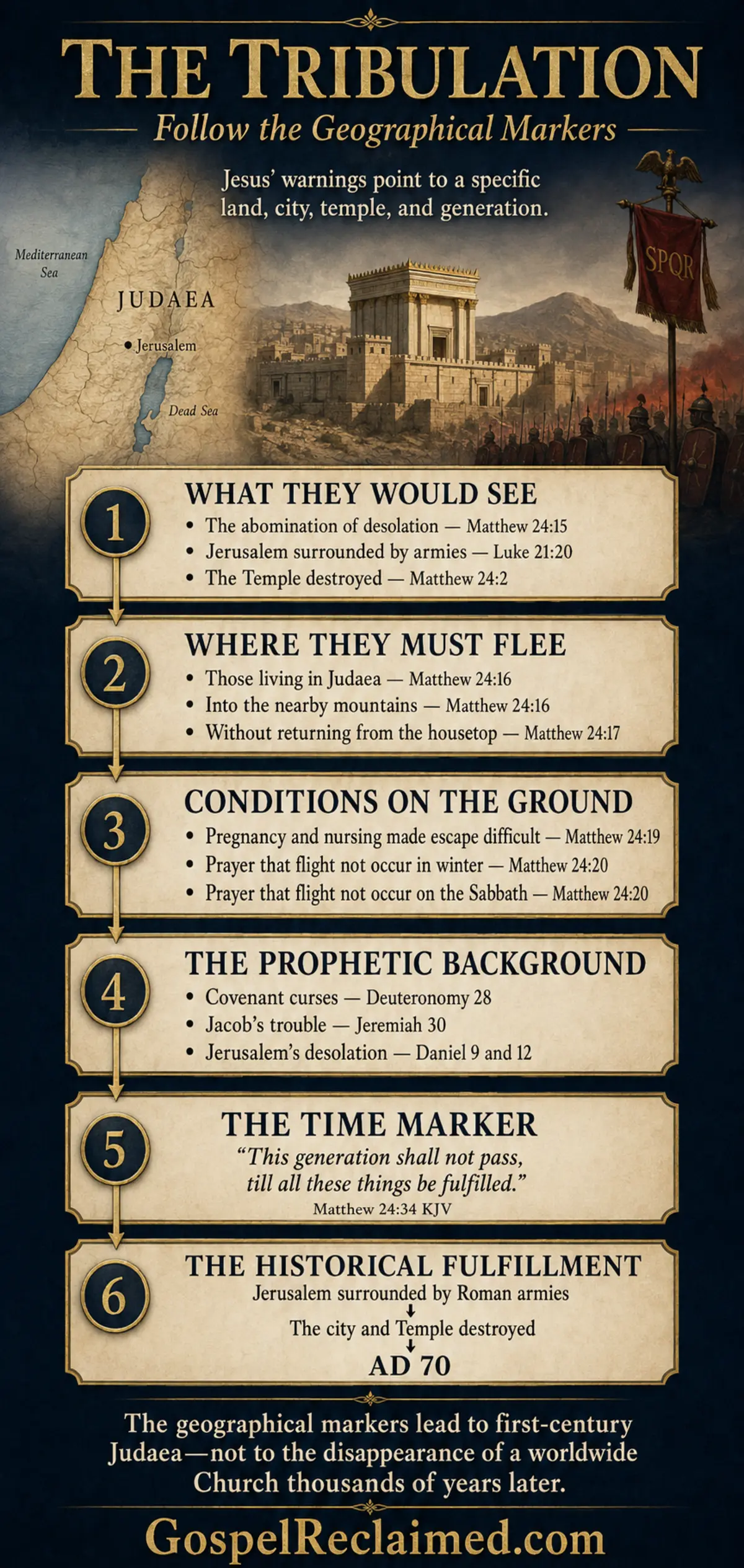
Nor is Jesus addressing an already-established worldwide Gentile Church. He is speaking privately to Jewish disciples about events involving their temple, city, land, Sabbath, and generation.
🌍 The commission to make disciples of all nations would come only after His resurrection (Matthew 28:19).
The context begins before Matthew 24. Jesus has pronounced judgment upon Jerusalem’s religious leaders, lamented over the city, and declared:
“Behold, your house is left unto you desolate.” — Matthew 23:38 KJV
As He leaves the temple, Jesus predicts that its magnificent buildings will be demolished:
“There shall not be left here one stone upon another, that shall not be thrown down.” — Matthew 24:2 KJV
The disciples naturally ask when “these things” will occur and what sign will mark His coming and “the end of the world” (Matthew 24:3 KJV). The Greek expression translated “end of the world” is synteleia tou aiōnos—the consummation or conclusion of an age, not the destruction of the planet.
Everything that follows remains rooted in this Jewish setting. Jesus refers to the holy place, tells those in Judaea to flee to the mountains, mentions the Sabbath, and describes distress upon the land (Matthew 24:15–22). He then gives the decisive time marker:
“Verily I say unto you, This generation shall not pass, till all these things be fulfilled.” — Matthew 24:34 KJV
Elsewhere in Matthew, “this generation” consistently refers to Jesus’ contemporaries (Matthew 11:16; 12:41–42; 23:36). Within their lifetime, Roman forces besieged Jerusalem and destroyed its temple in AD 70.
The comparison with Noah establishes the nature of Jesus’ warning:
“And knew not until the flood came, and took them all away; so shall also the coming of the Son of man be.” — Matthew 24:39 KJV
In the comparison, those who ignore the warning continue with ordinary life until judgment arrives unexpectedly. Noah and his household are prepared and preserved, while the others are swept away.
Matthew uses different verbs—airō for those taken away by the flood and paralambanō for the person “taken” from the field. The vocabulary alone therefore cannot determine the fate of each person. Nevertheless, the Noah comparison strongly warns against simply assuming that the person taken is a Christian transported to heaven. Jesus’ point is sudden separation when an approaching crisis finds some prepared and others unaware.
The discourse continues without introducing a rapture. Instead, Jesus moves from one illustration of preparedness to another:
- The watchful householder — Matthew 24:42–44
- The faithful and wicked servants — Matthew 24:45–51
- The wise and foolish virgins — Matthew 25:1–13
The next illustration brings Israel’s Bridegroom imagery to the foreground.
The Ten Virgins: Prepared to Receive the Bridegroom
“Then shall the kingdom of heaven be likened unto ten virgins, which took their lamps, and went forth to meet the bridegroom.” — Matthew 25:1 KJV
These virgins are wedding attendants, not ten literal women representing the entire human race at “the end of the world”. Five are wise [phronimoi]—prudent and prepared—while five are foolish. The distinction is not where they are taken, but whether they are ready to receive the Bridegroom when He arrives.
💡 This imagery belongs naturally to Israel’s covenant story.
The prophets repeatedly portrayed Israel as the Lord’s bride and described her covenant unfaithfulness, promised restoration, and anticipated reunion with her God (Isaiah 54:5–6; 62:1–5; Jeremiah 2:2; 31:4; Hosea 2:19–20).
Matthew has already identified Jesus as the Bridegroom:
“Can the children of the bridechamber mourn, as long as the bridegroom is with them?” — Matthew 9:15 KJV
He has also given the parable of a king preparing a wedding for his son. The original invitees reject the invitation, mistreat and kill the king’s servants, and their city is subsequently destroyed (Matthew 22:1–10). This is followed by Jesus’ confrontation with Jerusalem’s leaders, His lament over the city, and His prediction of the temple’s destruction.
The ten virgins therefore continue a pattern already established throughout Matthew. Israel was being confronted with the arrival of her Messiah and Bridegroom. Much of the nation—particularly its religious leadership—rejected Him, but a faithful and prudent remnant was prepared to receive Him.
The wise virgins represent those within Israel who recognized the Bridegroom and responded to His arrival. The foolish represent those who possessed the outward forms of expectation—the lamps—but remained unprepared for the very One they claimed to await.
The closed door is part of this prophetic warning about a covenantal opportunity being missed. It is not a literal picture of God permanently locking most of humanity out of salvation. Likewise, the five-to-five division does not predict that exactly half of Christians or half of humanity will be saved or taken. These are rhetorical pictures of separation between readiness and unreadiness within Israel.
⚠️ Nothing in this sequence mentions resurrection, bodily transformation, harpazō, ascent into the air, or seven years in heaven. Jesus is not describing the secret evacuation of a future Church. He is warning His Jewish disciples about the approaching crisis that would overtake their land, temple, city, and generation.
The controlling question throughout the discourse is not, “Who will disappear into heaven?” It is, “Who will be prepared to receive the Bridegroom when He comes?”
“One taken and one left” and the ten virgins form a first-century prophetic warning to Israel: judgment was approaching, the Bridegroom had come, and only the prudent were prepared to recognize and receive Him.
📖 Revelation 4:1 — “Come Up Hither”
“After this I looked, and, behold, a door was opened in heaven: and the first voice which I heard was as it were of a trumpet talking with me; which said, Come up hither, and I will shew thee things which must be hereafter.” — Revelation 4:1 KJV
This verse is sometimes presented as a symbolic rapture because the word “church” does not appear again until Revelation 22:16. Yet “Come up hither” is spoken specifically to John, who is invited to receive a vision.
The text never identifies John’s visionary ascent as the removal of the worldwide Church. Nor can the absence of the word “church” establish such an event when Revelation continues to mention saints, servants, and those faithful to Jesus.
Nothing in Revelation 4:1 describes the redeemed disappearing from the earth, receiving transformed bodies, or remaining in heaven during seven years of tribulation.
A Doctrine Constructed Between the Verses
These passages genuinely proclaim resurrection, bodily transformation, heavenly citizenship, salvation from orgē, preservation in trial, the manifestation of Christ’s glory, and permanent communion with Him.
What these passages do not proclaim is the pretribulation rapture system.
- First Corinthians 15 promises the resurrection of the dead, the transformation of the living, and the defeat of death at the last trumpet.
- First Thessalonians 5 says the redeemed are not appointed to orgē, but to obtain salvation through Jesus Christ.
- First Thessalonians 1 identifies Jesus as the One rescuing humanity from the coming orgē.
- Revelation 3 promises that Christ will guard the historical assembly in Philadelphia through an approaching time of trial.
- Titus 2 presents salvation as grace appearing for all people—training, redeeming, and purifying humanity—while identifying the blessed hope with the manifestation of Christ’s glory.
- Philippians 3 promises that Christ will transform the body of our humiliation into conformity with His glorious body and bring all things under His authority.
- John 14 promises that Christ’s departure will bring His disciples into permanent communion with Himself and the Father. Rather than describing their removal from the earth, Jesus promises that the Father and Son will come and make their abode with them.
- Matthew 24 warns Jesus’ Jewish disciples of sudden separation amid the approaching judgment upon their land, city, temple, and generation. It neither uses harpazō nor describes anyone ascending into heaven.
- Matthew 25 portrays Israel’s wise and foolish responses to the arrival of her Bridegroom—not the disappearance of the Church at the end of the world.
- Revelation 4 records John’s visionary summons to “come up hither” to receive a revelation. It does not portray the worldwide Church being removed from the earth.
Not one of these passages says that the Church will secretly disappear before seven years of worldwide tribulation.
Not one says that Christ will come for His Church, return with it to heaven, and then come again with it several years later.
Not one divides Israel and the Church into separate prophetic programs.
Not one describes a world of people left behind and given another opportunity after the Church has departed.
The doctrine, therefore, is not found in a verse. It is constructed in the spaces between verses—through meanings added to harpazō, a seven-year chronology drawn from elsewhere, a return to heaven inserted into Paul’s silence, orgē equated with tribulation, preservation redefined as evacuation, and passages from distinct arguments, audiences, and literary settings arranged to create a prophetic system that none of the biblical writers ever presents.
The Blessed Hope: The Appearing of Christ’s Glory
Questions will inevitably remain. Some readers will return to the imagery of Revelation or the warnings of Matthew 24–25 and interpret every mention of fire, darkness, or destruction as a prediction of the end of humanity.
Others will combine Jesus’ warnings about Jerusalem with Daniel’s seventy weeks—detaching the seventieth week from the rest—and relocate the entire crisis into a future seven-year tribulation.
Those passages deserve their own careful examination. Their prophetic background—including Daniel, Jacob’s trouble, Israel’s covenant warnings, and the approaching destruction of Jerusalem—cannot responsibly be compressed into a few closing paragraphs.
🔎 The purpose of this study has been narrower: to determine whether the New Testament passages commonly cited in support of the rapture actually teach the pretribulation system imposed upon them.
They do not.
But dismantling an escape narrative is not enough. If the secret removal of the Church is not the Christian hope proclaimed by Scripture, what is the blessed hope?
“Waiting for our blessed hope, the appearing of the glory of our great God and Savior Jesus Christ.” — Titus 2:13 ESV
The Greek reads more literally, “waiting for the blessed hope and the appearing of the glory of our great God and Savior Jesus Christ.” The second expression identifies the content of that hope: the blessed hope is the manifestation of Christ’s glory.
- Blessed [makaria] describes something joyful, favored, and beneficial.
- Hope [elpis] is confident expectation, not uncertain wishing.
- Appearing [epiphaneia] means manifestation, disclosure, or the act of becoming visible.
Nothing in Titus 2:13 identifies this hope as the secret disappearance of the Church, an escape from creation, or seven years hidden in heaven. The object of Christian expectation is Jesus Christ Himself and the full manifestation of His glory.
When Glory Invades the Darkness
Isaiah presents a striking picture in which darkness and glory exist within the same scene. The darkness is real, but it is not final:
“For, behold, the darkness shall cover the earth, and gross darkness the people: but the LORD shall arise upon thee, and his glory shall be seen upon thee. And the Gentiles shall come to thy light, and kings to the brightness of thy rising.” — Isaiah 60:2–3 KJV
Isaiah is speaking directly to Zion, but the light arising upon her finds its fulfillment in Jesus Christ. He is the Jewish Messiah through whom “salvation is of the Jews” (John 4:22)—the Light emerging from Israel and extending to the nations.
Simeon recognized this pattern when he called Jesus:
“A light to lighten the Gentiles, and the glory of thy people Israel.” — Luke 2:32 KJV
Isaiah’s vision is not of God rescuing His people by removing them from the darkness. The Lord arises upon Zion, His glory becomes visible, and the nations are drawn toward that light. Christ’s glory shines outward from Israel for the illumination of the world.
🕊️ The divine answer to darkness is not evacuation, but illumination.
Revelation 21 clearly echoes Isaiah’s vision:
- The nations come to the light — Isaiah 60:3; Revelation 21:24
- Kings bring their glory into the city — Isaiah 60:11; Revelation 21:24–26
- Its gates remain continually open — Isaiah 60:11; Revelation 21:25
- God becomes its everlasting light — Isaiah 60:19–20; Revelation 21:23
- Mourning ends, and sorrow and death pass away — Isaiah 60:20; Revelation 21:4
Revelation identifies the source of that light:
“For the glory of God did lighten it, and the Lamb is the light thereof.” — Revelation 21:23 KJV
The holy city itself comes down from God out of heaven (Revelation 21:2, 10). The end, declared from the beginning (Isaiah 46:10-11), is not the evacuation of humanity from creation, but the dwelling of God coming down to humanity and filling creation with His presence (Revelation 21:3; Habakkuk 2:14; Ephesians 1:23; 1 Corinthians 15:28).
The biblical story does not end with the nations permanently abandoned in darkness. Salvation comes through Israel in Christ and flows outward to the nations. The nations walk by the city’s light, and the kings of the earth bring their glory into it (Revelation 21:24–26).
The darkness does not overcome the Light, Zion—representing the redeemed—is not evacuated from the earth, and the nations are not forsaken. The Lamb becomes their light, and the nations walk in His radiance.
The Biblical End: All Things Gathered into Christ
When Scripture describes the purpose toward which history is moving, its language is not abandonment, evacuation, or the permanent triumph of death over most of creation.
It speaks of restoration [apokatastasis ]:
“The times of restoration of all things…” — Acts 3:21
It speaks of all things being gathered into Christ:
“That… he might gather together in one all things in Christ, both which are in heaven, and which are on earth…” — Ephesians 1:10
It speaks of reconciliation through the cross:
“And, having made peace through the blood of his cross, by him to reconcile all things unto himself…” — Colossians 1:20
It speaks of humanity being made alive in Christ:
“For as in Adam all die, even so in Christ shall all be made alive.” — 1 Corinthians 15:22
It speaks of the destruction of the final enemy:
“The last enemy that shall be destroyed is death.” — 1 Corinthians 15:26
It speaks of creation itself being liberated:
“The creature itself also shall be delivered from the bondage of corruption into the glorious liberty of the children of God.” — Romans 8:21
It speaks of the completion of Christ’s reign:
“And when all things shall be subdued unto him… that God may be all in all.” — 1 Corinthians 15:28
And at the conclusion of Revelation, the One seated upon the throne declares:
“Behold, I make all things new.” — Revelation 21:5 KJV
🌍 This is the blessed hope: the glory of Jesus Christ fully unveiled, creation liberated from corruption, death destroyed, the nations walking in the light of the Lamb, and all things gathered into Christ.
Scripture’s stated destination is resurrection, reconciliation, liberation, renewal, and God becoming all in all. The Bible does not end with God abandoning His creation after rescuing a fraction of humanity from it. It ends with the triumphant declaration of the One who sits upon the throne:
“Behold, I make all things new.”
- Historical Note: Why Were the Thessalonians Troubled About the Dead?
Paul does not say that the Thessalonians were afraid of dying. He says they were grieving and were “uninformed…about those who are asleep” (1 Thessalonians 4:13). Nor does the letter specifically identify the deceased as biological family members. They were members of this young Christian community—friends, loved ones, and perhaps relatives—whose deaths raised an urgent question: Would those who died before Christ’s anticipated parousia miss the event or be placed at a disadvantage to those who remained alive?
The wording of Paul’s answer reveals the nature of their concern. The living “will not precede” those who have died; “the dead in Christ will rise first”; and both groups will be gathered “together” to meet the Lord (1 Thessalonians 4:15–17). Paul is therefore not primarily explaining how living Christians will escape the earth. He is assuring a grieving community that death cannot exclude its deceased members from Christ’s presence or sever their fellowship with those who remain alive.
Several circumstances help explain their confusion. The Thessalonian assembly was young, Paul’s founding ministry had ended abruptly, and he acknowledged his desire to return and “supply what is lacking” in their understanding (1 Thessalonians 2:17–18; 3:10). They had been taught to “wait for [God’s] Son from heaven” (1:10), but apparently had not yet understood what would happen if some of them died before His parousia. Their deaths therefore created an unexpected theological and relational crisis.
The community was also living under genuine pressure. First Thessalonians says they received the message in “much affliction” (1:6), suffered hostility from their own countrymen (2:14), and continued to experience affliction after Paul’s departure (3:3–5). Second Thessalonians likewise refers to “all your persecutions and…afflictions” and to their need for relief and reassurance (2 Thessalonians 1:4–7). Acts 17:1–10 supplies a plausible historical setting: a mob attacked Jason’s house, members of the community were dragged before the city authorities, and Paul’s proclamation was politically recast as allegiance to “another king, Jesus.”
This was local hostility, however—not an empire-wide Roman extermination of Christians. First Thessalonians was probably written around AD 50, years before Nero’s persecution in Rome in AD 64. The letters also never say that the deceased Thessalonians were martyrs. Persecution may have intensified the community’s vulnerability and anxiety, but whether these particular deaths resulted from persecution, illness, or ordinary mortality cannot be determined.
The social world of Thessalonica adds another dimension. Ancient voluntary associations frequently functioned as extended families, caring for deceased members through burial and commemoration. Death consequently raised questions of belonging as well as personal survival: Did those who died remain part of the community, and would the living be reunited with them? Paul’s answer is emphatic. The dead have not been lost, abandoned, or left behind. They remain in Christ, they rise first, and the living are gathered together with them. That is why the passage ends, not with speculation about a tribulation timetable, but with the pastoral command: “Therefore encourage one another with these words.” ↩︎
FAQs
Is the rapture taught in the Bible?
Scripture teaches resurrection, bodily transformation, and the gathering of humanity to Christ. It does not present the pretribulation system of a secret disappearance followed by seven years in heaven.
Does 1 Thessalonians 4 describe a secret rapture?
No. The passage describes the Lord descending with a shout, the voice of an archangel, a trumpet, the resurrection of the dead, and a public meeting in the clouds—hardly a secret event.
When did the pretribulation rapture doctrine begin?
The doctrine developed into its recognizable theological system during the nineteenth century, particularly through John Nelson Darby, and was later popularized through the Scofield Reference Bible and modern evangelical media.